Reset
"Behold, the days are coming, says the LORD, when I will make a new covenant with the house of Israel and with the house of Judah— not according to the covenant that I made with their fathers in the day that I took them by the hand to lead them out of the land of Egypt, My covenant which they broke, though I was a husband to them, says the LORD. But this is the covenant that I will make with the house of Israel after those days, says the LORD: I will put My law in their minds, and write it on their hearts; and I will be their God, and they shall be My people. No more shall every man teach his neighbor, and every man his brother, saying, 'Know the LORD,' for they all shall know Me, from the least of them to the greatest of them, says the LORD. For I will forgive their iniquity, and their sin I will remember no more."” (Jer 31:31-3NKJV)
Our entire relationship with God is based on the power of covenant. God is incapable of lying and when He makes a covenant it is forever. There is no such thing as an old covenant. There is only the continuation of covenant. To use the term old covenant there has to be something that wears out. There is only eternal covenant. SO, we can ask, if there is no “old covenant” then how can there be a new covenant? Good question. The reason there can be a new covenant is because God as the covenant maker can always improve on the deal. God has made several covenants in the dealing s with man, but they always improve the deal does not annul the deal.
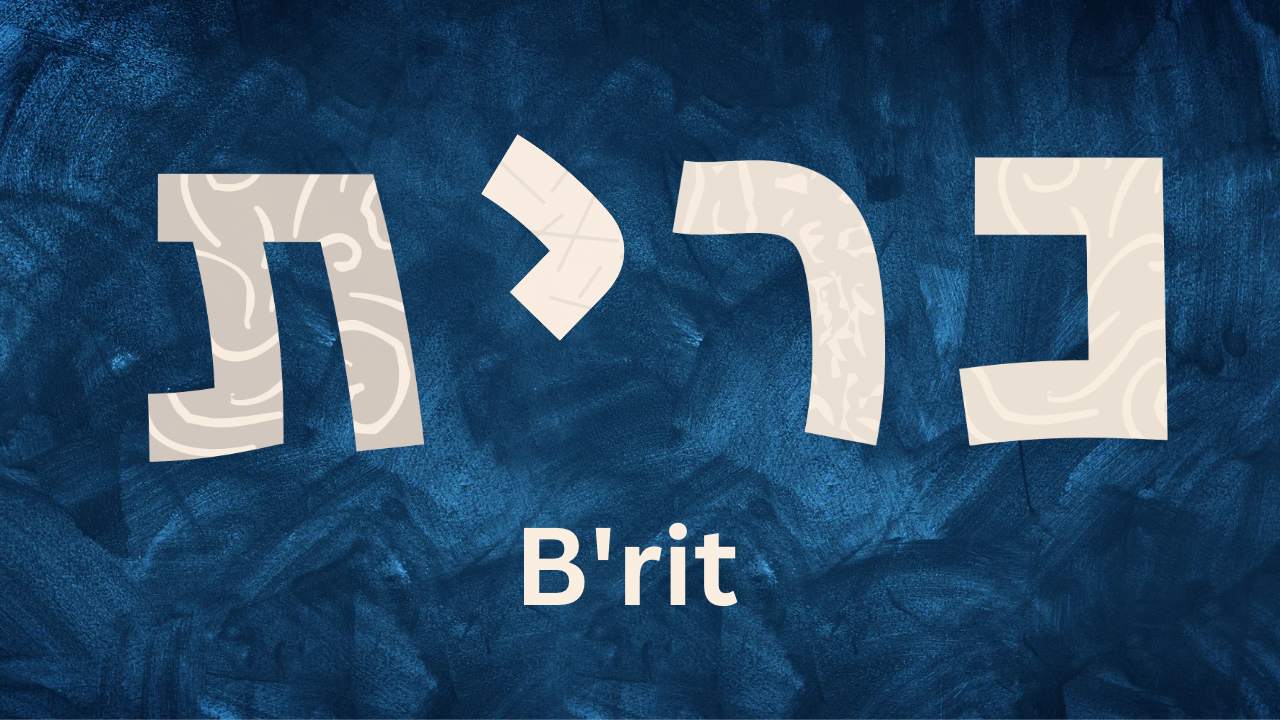
Let’s unravel the word first to get some idea of what a covenant actually is from the Hebrew Letters. The word is “brit”. The letters are the bet, the resh, the yod, and the tav. Last session when we looked at “bereshit” we saw a similar pattern.
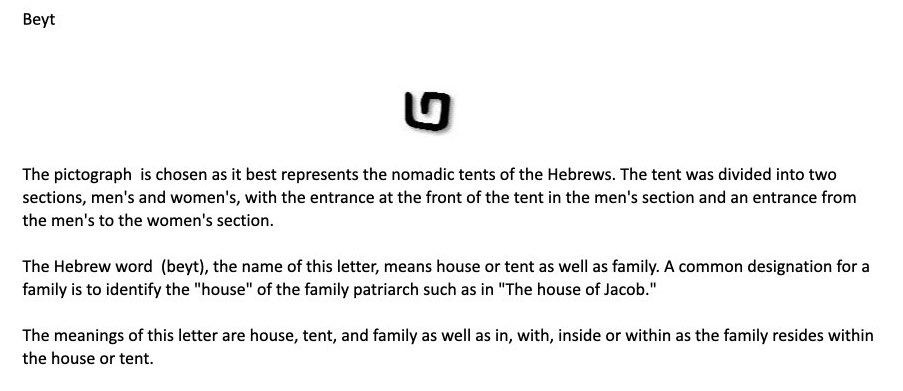
Beginning with the letter bet, we remember that it is the picture of a house or a dwelling and begins the scripture with an invitation to enter in. When you add a bet to a word, you are inviting someone to go inside that word. The term in Christ, would in Hebrew b’Mashiach. More commonly it is used in the name of Yeshua, b’shem Yeshua in prayer. In its simplest form the “bet” is an invitation to oneness, to covenant. It implies all of the intimacy, trust, protection and identity of the one who invites and the one who accepts.
The closest experiential concept we have to this is the wedding proposal and the acceptance.
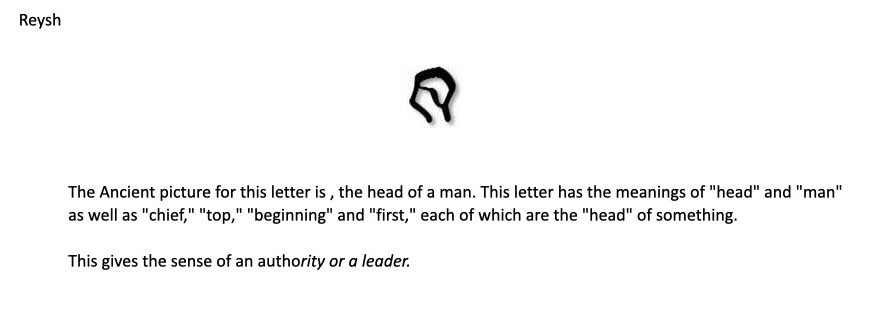
The second letter of brit is again similar to bereshit, the resh. The resh is the pictograph of a head and means the authority of a person or a place. When you combine the bet and the resh, you get the word picture for “bar” which means the “son” or the invitation into the authority of the son. The son is the future of a home, the promise of its Glory. When a home has a son, it has a future. This is why the primary family centered covenant of the Bible was to promise a son to Abraham. Without a son Abraham would have had no future, no hope of glory.
God gives Him a future by in covenant giving Him a son, Isaac.
“Then behold, the word of the LORD came to him, saying, “This man will not be your heir; but one who will come from your own body shall be your heir.”” (Gen 15:4, NASB)
“On that day the LORD made a covenant with Abram, saying, “To your descendants I have given this land, From the river of Egypt as far as the great river, the river Euphrates:” (Gen 15:18, NASB)
The promise of a son, Isaac through whom Abraham would have an inheritance which reaches through faith to us today begins with the “bar” of the word “brit”.
Of course, for the new covenant, the brit hadasha, we see again the provision of the Son is the doorway to the Glory of the Covenant which is the inheritance for the Father of His Sons and Daughters. We tend to view our salvation from our own sin and our own redemption. What is often overlooked is what it means to the Father.
For the Father the redemption of the sons and daughters is His inheritance.
“In Him we also have obtained an inheritance, having been predestined according to the purpose of Him who works all things in accordance with the plan of His will, to the end that we who were the first to hope in the Christ would be to the praise of His glory. In Him, you also, after listening to the message of truth, the gospel of your salvation—having also believed, you were sealed in Him with the Holy Spirit of the promise, who is a first installment of our inheritance, in regard to the redemption of God’s own possession, to the praise of His glory.” (Eph 1:11-14, NASB)
This is a covenant verse section. The term the praise of His glory, is a reference to the Father having something to praise or celebrate. What is He celebrating? His Glory, His inheritance, His sons, and daughters. We are His possession, His inheritance, His future. I know it is difficult to realize that God who could just have easily begun over and created a new race to be His children, chose instead the path of redemption which includes the place of the Son, His Bar, Yeshua. He bases all of this on the covenant, the brit hadasha, which is inaugurated by the blood of the Son.
Similar to bereshit, brit begins with son. Not is the son the fioundation stone of creation, he also is the means of the covenant that produces the offspring of the Father, the inheritors of eternal life!
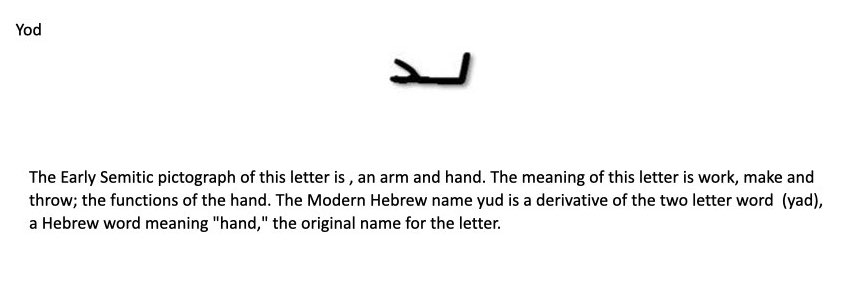
Next, we see the yod, the symbol for hand or arm and means the power behind something or someone. In the case of God’s covenant, He is the absolute power behind the promise.
““Assuredly My hand founded the earth, And My right hand spread out the heavens; When I call to them, they stand together.” (Isa 48:13, NASB)
There are many more scriptures where God uses the picture of His hand being the expression of His power.
Adding the yod to the word brith means that through the Son He gives us His word. It is by His own power that we enter into the new covenant. He provides the covenant sacrifice.
“but He, having offered one sacrifice for sins for all time, SAT DOWN AT THE RIGHT HAND OF GOD,” (Heb 10:12, NASB)
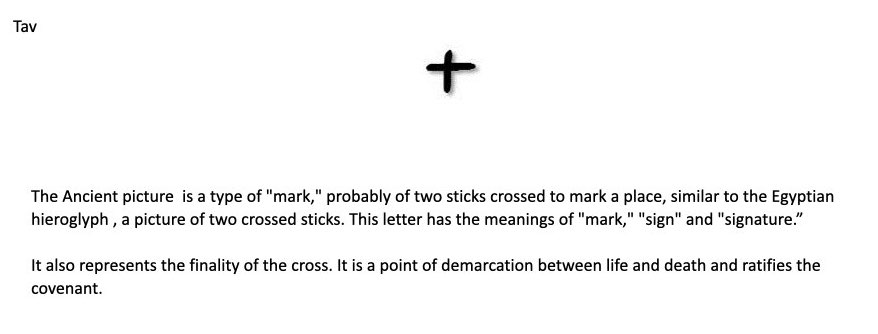
The final symbol that seals the covenant is the symbol of death, the cross, the tav. This is the x marks the spot. It tells us that God’s covenants are sealed by death.
Death, Met, in Hebrew is how a covenant is made. Hebrews tells us:
“For this reason He is the mediator of a new covenant, so that, since a death has taken place for the redemption of the violations that were committed under the first covenant, those who have been called may receive the promise of the eternal inheritance. For where there is a covenant, there must of necessity be the death of the one who made it. For a covenant is valid only when people are dead, for it is never in force while the one who made it lives.” (Heb 9:15-17, NASB)
In order for the new covenant to enhance the earlier covenants it must have satisfaction of the terms. Since God makes His covenants unilaterally and unconditionally, He could only bring about a new covenant through His own death. He died in Yeshua. We also died in Yeshua. Yeshua’s death is the cross, the x that marks the spot for a new life, eternal life.
This is revealed in us as the sign of the tav. Let’s look a couple of places where the significance of the tav is at the end of the covenant. It represents the mark on those sealed by God.
“And the LORD said to him, “Go through the midst of the city, through the midst of Jerusalem, and make a mark on the foreheads of the people who groan and sigh over all the abominations which are being committed in its midst.”” (Ezk 9:4, NASB)
This is a mark of hearts that are tender towards the things of God and broken by the abominations and desolations that are being done in Jerusalem. This is precursor for the abomination that Daniel prophesies at the end. This mark protects the people with heart towards God from the judgment.
“Utterly kill old men, young men, female virgins, little children, and women, but do not touch any person on whom is the mark; and you shall start from My sanctuary.” So, they started with the elders who were before the temple.” (Ezk 9:6, NASB)
The mark of God that is given to these faithful ones is the sign of the tav, the X of God. Covenant protects us from judgement.
Now let’s turn to Revelations 9:4
“They were told not to hurt the grass of the earth, nor any green thing, nor any tree, but only the people who do not have the seal of God on their foreheads.” (Rev 9:4, NASB)
Again we see a judgment coming to the earth, but those who have the seal of God on their foreheads are again protected. This is again the power of the cross, the tav. We are marked with the covenant seal, the tav.
Paul says it this way:
“Or do you not know that all of us who have been baptized into Christ Jesus have been baptized into His death? Therefore, we have been buried with Him through baptism into death, so that, just as Christ was raised from the dead through the glory of the Father, so we too may walk in newness of life. For if we have become united with Him in the likeness of His death, certainly we shall also be in the likeness of His resurrection, knowing this, that our old self was crucified with Him, in order that our body of sin might be done away with, so that we would no longer be slaves to sin; for the one who has died is freed from sin. Now if we have died with Christ, we believe that we shall also live with Him, knowing that Christ, having been raised from the dead, is never to die again; death no longer is master over Him. For the death that He died, He died to sin once for all time; but the life that He lives, He lives to God. So you too, consider yourselves to be dead to sin, but alive to God in Christ Jesus.” (Rom 6:3-11, NASB)
This is the description of the death that marks the brit, the covenant. We are marked eternally with the sign of the cross invisible on our foreheads in the natural but blazing with fire in the spirit.

Last chapter, we began looking at the deliverance that comes from righteousness. In Hebrew, righteousness is the word, Tzadak composed of the 3 letters, tzade, dalet, and kuf. The composite word picture is of the seed of God, His spoken creative word, that we open our heart to through the gates of our heart and in that choice bring forth a new day with new possibilities and goodness.
1 John 3:7-10 Tells us that righteousness is a spiritual practice, involving more than just “being” righteous but an opportunity to activate ourselves in righteousness. John tells us that anyone who does not practice righteousness is not of God.
The scriptures teach us that we have spiritual senses which are developed through use like our natural senses:
“But solid food belongs to those who are of full age, that is, those who by reason of use have their senses exercised to discern both good and evil.” (Hebrews 5:14)
This is an important aspect of our maturity in the Lord, like any skill, natural or supernatural, we must grow in grace with focused intent.
“You therefore, beloved, since you know this beforehand, beware lest you also fall from your own steadfastness, being led away with the error of the wicked; but grow in the grace and knowledge of our Lord and Savior Jesus Christ. To Him be the glory both now and forever. Amen.” (2 Peter 3:17-18)
Grace, as we remember from earlier sessions, is the Hebrew word “chen”. This is the same root as the word for “rest” and “favor”. It is the word picture of a fence that protects and nourishes the seed of God’s word. The clearest picture in the natural is the womb. The seedling child is kept safe and nurtured in the womb. Each of us in a seed of the Lord. His grace keeps us safe and nurtures us. Like the placenta in the natural, God nurtures us through life giving communication. This is His grace.
“For by grace you have been saved through faith, and that not of yourselves; it is the gift of God,” (Ephesians 2:8)
Faith is the substance that comes through His speaking to our heart. Because God is a Creator and He creates by speaking, His communication to our heart is not merely words, but eternal life. Paul calls this a gift, deposit that comes from God into our hearts. For what purpose? Our destiny.
“Who has saved us and called us with a holy calling, not according to our works, but according to His own purpose and grace which was given to us in Christ Jesus before time began,” (2 Timothy 1:9)
We are born by grace with eternal purpose that existed in God before the fall. This is redemptive purpose. This purpose is also known as righteousness.
“I said in my heart, "God shall judge the righteous and the wicked, for there is a time there for every purpose and for every work."” (Ecclesiastes 3:17)
From this perspective, our righteousness is tied to our purpose. We were born for this time. The seed of God, His creative power that we open our heart to, brings about a new day, a new reality with purpose. Let’s go a little deeper now into righteousness.
“For the LORD knows the way of the righteous, But the way of the wicked will perish.” (Psalms 1:6)
The Lord “knows” the way of the righteous. The way of the righteous is the path that arises out of intimate knowing of the Lord. This word “knows” here is yadah, which is an intimate oneness. Righteousness and intimacy with Lord are the same. It is also called abiding.
“Abide in Me, and I in you. As the branch cannot bear fruit of itself, unless it abides in the vine, neither can you, unless you abide in Me. "I am the vine, you are the branches. He who abides in Me, and I in him, bears much fruit; for without Me you can do nothing. If anyone does not abide in Me, he is cast out as a branch and is withered; and they gather them and throw them into the fire, and they are burned.” (John 15:4-6)
Do you see the contrast between abiding, fruit, and not abiding and wickedness? You see, mostly we focus on the outside and miss the true reality which is the righteousness that comes from intimacy.
Apart from intimacy there is no righteousness. This doesn’t mean that righteousness guarantees sinlessness. No! Even the most righteous among us, misses the mark from time to time. That is part of learning.
“My little children, these things I write to you, so that you may not sin. And if anyone sins, we have an Advocate with the Father, Jesus Christ the righteous.” (1 John 2:1)
Yeshua is the righteous One without sin. Yet we are righteous and still make mistakes. This is because we are still learning how to walk as he walked. That is why he stands as our advocate to intercede for us in our mistakes.
We are anointed to activate righteousness.
“But the anointing which you have received from Him abides in you, and you do not need that anyone teach you; but as the same anointing teaches you concerning all things, and is true, and is not a lie, and just as it has taught you, you will abide in Him. And now, little children, abide in Him, that when He appears, we may have confidence and not be ashamed before Him at His coming. If you know that He is righteous, you know that everyone who practices righteousness is born of Him.” (1 John 2:27-29)
It is said that practice makes perfect. This isn’t true because even the most practiced at something will still occasionally make mistakes, what the Bible calls sin. Yet that is not the point. The point is who we become in the practice of righteousness, which is the practice of our purpose.
Being born of Him is righteousness. It is the seed of His that we receive into our heart that opens us the new day of possibility before us, the hope of Glory!
Paul describes this process of righteousness this way:
“Of which I became a minister according to the stewardship from God which was given to me for you, to fulfill the word of God, the mystery which has been hidden from ages and from generations, but now has been revealed to His saints. To them God willed to make known what are the riches of the glory of this mystery among the Gentiles: which is Christ in you, the hope of glory. Him we preach, warning every man and teaching every man in all wisdom, that we may present every man perfect in Christ Jesus. To this end I also labor, striving according to His working which works in me mightily.” (Colossians 1:25-29)
The “perfection” Paul is speaking about, is a description not just of the goal but the fulfillment of the purpose. Each of us is righteous in the pursuit of our purpose which is a continual revealing, hope through the unravelling of the mystery.
We are a mystery to ourselves and of course, in some ways to others but NOT to God who purposed us in His wisdom and plan.
“For we were saved in this hope, but hope that is seen is not hope; for why does one still hope for what he sees? But if we hope for what we do not see, we eagerly wait for it with perseverance. Likewise the Spirit also helps in our weaknesses. For we do not know what we should pray for as we ought, but the Spirit Himself makes intercession for us with groanings which cannot be uttered. Now He who searches the hearts knows what the mind of the Spirit is, because He makes intercession for the saints according to the will of God. And we know that all things work together for good to those who love God, to those who are the called according to His purpose.” (Romans 8:24-28)
We are in hope for His righteousness to be made manifest in and through our lives. He intercedes for us in that pursuit because He alone knows the mind of the Sprit for us, what is His true plan for each of us. We can trust that he works all things together for good, for our perfection in righteousness.
Activation: We can discover our purpose by trusting that God has already worked everything in our lives for good. The relationships and roles in those relationships are the interconnections he uses to manifest our role in his plan. Becoming aware of the roles our relationships serve in our manifestation of righteousness is critical to growing in grace. Make a list of the critical relationships that are in our life. Ask him to reveal to you what you need to see about the people in those relationships. Don’t ignore the difficult ones. That is where perseverance is needed.

Deliverance and discipleship are one and the same. We are delivered from slavery to the world and its mind control dehumanizing system and into our identity and destiny in the Lord, as His disciples. No to different from fictional accounts of mental and physical programming, the world uses techniques to do the same to our souls. Thoughts or as the scripture names them strongholds define our reality. These are fortresses of thought that the world and Satan has imparted into the fabric of our hearts that can bring us into a bondage in those respective areas. Paul describes this process like this:
For though we walk in the flesh, we do not war according to the flesh. For the weapons of our warfare are not carnal but mighty in God for pulling down strongholds, casting down arguments and every high thing that exalts itself against the knowledge of God, bringing every thought into captivity to the obedience of Christ, (2Co 10:3-5)
Strongholds or mental fortresses need to be cast down as arguments or reasonings. These are called “high things” that raise themselves up against the knowledge of God. The activation spiritually, described as “casting down” is a deliberate act of authority in opposition to the world’s mindset.
One the weapons of this warfare of the mind and heart is the truth.
And you shall know the truth, and the truth shall make you free." (Joh 8:32)
The key is to “know” the truth. The Hebrew word for “knowing” is yadah. We have studied this earlier but as a refresher the word contains the word “yad” which means the hand. In ancient Hebraic thinking, you only know something truly if you use it effectively. This use is symbolized by the hand.
When Abraham rescued his nephew lot from the enemy kings, Melchizedek, the priest of God received His tithe as an expression of the victory of Abraham yielding his “hand” to God.
And he blessed him and said: "Blessed be Abram of God Most High, Possessor of heaven and earth; And blessed be God Most High, who has delivered your enemies into your hand." And he gave him a tithe of all. Now the king of Sodom said to Abram, "Give me the persons, and take the goods for yourself." But Abram said to the king of Sodom, "I have raised my hand to the Lord, God Most High, the Possessor of heaven and earth, that I will take nothing, from a thread to a sandal strap, and that I will not take anything that is yours, lest you should say, 'I have made Abram rich'-- (Gen 14:19-23)
Melchizedek calls Abraham’s victory the deliverance of his enemies into his hand. Abraham, in turn declares that is God alone who he has lifted up his hands to. The hand of Abraham is the symbol of his exercise of his Godly authority. Abraham in turn lifts his hands only to worship the Lord. In this picture we can see how the hand, the yad defines who we are and whose we are.
Yadah adds the “hey” to the hand which is the character for revelation. Knowing” reveals who we are and who we have yielded ourselves to.
Returning now to John 8:32, when we “know” the truth, the “truth” has the power to set us free.
How can we “know” the truth? Through the Holy Spirit.
However, when He, the Spirit of truth, has come, He will guide you into all truth; for He will not speak on His own authority, but whatever He hears He will speak; and He will tell you things to come. (Joh 16:13)
This is a very interesting verse because Yeshua not only tells us that the person of the Holy Spirit is our guide into knowing the truth, but also that when He reveals truth to us, it reveals the future to us. This could be a reference to prophecy about the future, but it could also be that when we are freed from lies into truth, we can live out our purpose and destiny.
You see we all live up to the future we believe is our destiny. If we believe lies about ourselves then we act in accordance with those lies. This is the conversation of the heart that sets our belief boundaries. In this way, lies and bondages to those lies can corrupt our purpose and destiny.
The salvation of the Lord is not only to forgive us for our sins but also to liberate us to live into our destiny.We are translated from darkness, lies into light, truth.
Eph 5:8 for you were once darkness, but now you are light in the Lord; walk as children of light
Our walk is another way of describing what empowers us. Truth or lies.
The Apostle Paul describes this in several places.
Now the Lord is the Spirit; and where the Spirit of the Lord is, there is liberty. But we all, with unveiled face, beholding as in a mirror the glory of the Lord, are being transformed into the same image from glory to glory, just as by the Spirit of the Lord. (2Co 3:17-18)
We are being liberated from false images in our heart, truth by truth, glory by glory. We are being led into our true identity as children of God.
For as many as are led by the Spirit of God, these are sons of God. For you did not receive the spirit of bondage again to fear, but you received the Spirit of adoption by whom we cry out, "Abba, Father." The Spirit Himself bears witness with our spirit that we are children of God, and if children, then heirs--heirs of God and joint heirs with Christ, if indeed we suffer with Him, that we may also be glorified together. (Rom 8:14-17)
The key to this all is the truth.
The word truth is “emet” in Hebrew. The three letters are the first in the alphabet, the aleph, the middle letter mem, the final letter tav. Positionally this is telling us that the truth is in the language, or in the word.
Aleph is the character of an ox and represents power or strength. It is the representation of the first born son Yeshua. The mem, as we have mentioned before is the letter for water, which means chaos. The tav is the symbol of the cross and is the end or purpose of the word.
Yeshua told us in Revelations that He is the beginning and the end.
I am the Alpha and the Omega, the Beginning and the End, the First and the Last." (Rev 22:13) In Hebrew it would be the aleph and the tav.
If you think of Him as the aleph and the tav, and life in between as the mem, the chaos, He then defines the purpose and the destiny of life. I like to think in analogies. Think of a guitar string as our life. It is defined by the beginning, the aleph and the end the tav. When the string is tuned it is adjusted in length by the pegs which determine the correct length to make the pure sound intended for that string. Yeshua is the aleph and the tav. He defines the length of our days and makes the pure sound to come out of the chaos or the mem. This is the power of Him who is the emet.
Jesus answered, "I am the way and the truth and the life. No one comes to the Father except through me. If you really know me, you will know my Father as well. From now on, you do know him and have seen him." (Joh 14:6-7)
Knowing Yeshua and knowing the Father is the truth, the emet. When we surrender to Him as the truth our life comes into harmony with the notes of creation. This is true freedom.
Life is inherently chaotic, unpredictable and can change drastically in an instant. In addition, we live in times where the “truth” is what the government and the media say it is. Under the banner of “science” and the threats of propagating misinformation pressure is mounting on people to conform to narratives and agendas which have questionable validity.
The Apostle Paul spoke to this kind of mob mentality:
Therefore, do not let anyone judge you by what you eat or drink, or with regard to a religious festival, a New Moon celebration or a Sabbath day. These are a shadow of the things that were to come; the reality, however, is found in Christ. Do not let anyone who delights in false humility and the worship of angels disqualify you. Such a person also goes into detail about what they have seen; they are puffed up with idle notions by their unspiritual mind. They have lost connection with the head, from whom the whole body, supported and held together by its ligaments and sinews, grows as God causes it to grow. Since you died with Christ to the elemental spiritual forces of this world, why, as though you still belonged to the world, do you submit to its rules: "Do not handle! Do not taste! Do not touch!"? These rules, which have to do with things that are all destined to perish with use, are based on merely human commands and teachings. (Col 2:16-22)
This passage was written to address the religious authorities of his day. The net effect is that we will all face pressures to conform whether it is as useless as covering our faces with cloth to keep us and others safe or allowing ourselves to be injected with dangerous concoctions that somehow are supposed to mitigate illness and yet seem to magnify the very thing they were supposed to help. Ultimately these are all attempts to corrupt the power that is found in the aleph and the tav which is the Word who is Messiah Yeshua.
As we go forward, we are being encouraged to abandon our trust in He who is the truth and lose trust in the Spirit of Truth who lives in us to lead us into freedom.
Activation: Let’s pause and ask the Lord to speak to us about His truth for us. Probably the most important question to ask is that which validates our sonship in Him. Let’s ask Him to speak to who we are in Him? Ask, who am I to you?
Next ask Him how is who am I related to my purpose and destiny?

Deliverance as we have stated is rescuing us from the Egypt of this world into the promised land of our inheritance. This deliverance is first and foremost an inside job. When Israel entered the Land of Promise, the Manna stopped.
On the day after the Passover, on that very day, they ate some of the produce of the land, unleavened cakes and parched grain. The manna ceased on the day after they had eaten some of the produce of the land, so that the sons of Israel no longer had manna, but they ate some of the yield of the land of Canaan during that year. (Jos 5:11-12)
This is a very important success principle. Deliverance from Egypt was celebrated by the Passover. Our deliverance from the world system is celebrated by communion, a picture of the Passover. Manna represents provision in the wilderness, the period where God heals our life and removes the reproach of sin, and Egypt.
Then the LORD said to Joshua, "Today I have rolled away the reproach of Egypt from you." So the name of that place is called Gilgal to this day. (Jos 5:9)
Reproach, is another word for shame, which is an identity or self-worth statement. This process is related to manna. Mannadefines the time of sequestered Fatherly impartation. We eat the bread of His provision which is really the Word which builds our image in Him, our character and our sense of worth. This process is about releasing us from the “Egypt” of our lives.
But He answered and said, "It is written, 'MAN SHALL NOT LIVE ON BREAD ALONE, BUT ON EVERY WORD THAT PROCEEDS OUT OF THE MOUTH OF GOD.'" (Mat 4:4)
In this way the Word of God is the bread of God made living. If we think in terms of a developing life, Israel was birthed as a nation out of Egyptian bondage and grew up in the wilderness and then matured into their destiny in the Land of Promise. The desert time was training time in the ways of God. As Believers we often find ourselves back in the desert amid our trying to live into our inheritance. We often need some manna to break free from the hidden reefs in our hearts. Have you ever wondered. How can you go from feeling good to suddenly out of controland feeling unmoored by people or situations in your life?
Jude describes this reality:
“These are the ones who are hidden reefs in your love feasts when they feast with you without fear, like shepherds caring only for themselves; clouds without water, carried along by winds; autumn trees without fruit, doubly dead, uprooted; wild waves of the sea, churning up their own shameful deeds like dirty foam; wandering stars, for whom the gloom of darkness has been reserved forever.” (Jude 1:12-13)
Even in our times of feeling like things are going along pretty well we can suddenly discover that our lives have been infiltrated by things from our past pain that undermine our sense of safety and security. Jude tells us that the danger is very present. Egypt is always just around the corner in our lives and want to drag us back into slavery.
God is always there to give us fresh manna. But He also wants us to learn how to live in current time and reap from our own efforts. The ceasing of manna and consuming the produce of the Land is the equivalent of us living from our calling in God, our destiny in our Land of Promise.
There are many believers who have become wilderness believers. They refuse to mature into kingdom possession believers. We see this especially true when it comes to finances and provision. It is easier to live waiting for more manna versus maturing into a profession or a calling that provides the fruit of that land.
These deliverance teachings have been emphasizing spiritual activations that are like gym training in the Holy Spirit Gym for possessing our inheritance.
Our verse for today tells us that being steadfast in our thoughtsand heart will bring us into a peace that reflects our trust in God.
The Hebrew Word “samach” is our next power word, which is translated as steadfast or as being supported and is most often what happens when hands are laid on the head in impartation. In all cases there is some kind of transference of power and confidence.
"The steadfast of mind You will keep in perfect peace, because he trusts in You. (Isa 26:3)
Looking at the ancient Hebrew pictographs, we have first, the letter samech, which shares the pronunciation with the word and is the picture of a thorn. Thorns are used to protect something but also to pierce into something. Thorns are defensive but also leave a reminder of the trespass.
Paul described God dealing with his pride by the picture of a thorn.
Because of the surpassing greatness of the revelations, for this reason, to keep me from exalting myself, there was given me a thorn in the flesh, a messenger of Satan to torment me—to keep me from exalting myself! (2Co 12:7)
The thorns also are the representation of authority in Messiah as represented by the crown of thorns.
And the soldiers twisted together a crown of thorns and put it on His head and put a purple robe on Him; and they began to come up to Him and say, "Hail, King of the Jews!" and to give Him slaps in the face. Pilate came out again and *said to them, "Behold, I am bringing Him out to you so that you may know that I find no guilt in Him." Jesus then came out, wearing the crown of thorns and the purple robe. Pilate *said to them, "Behold, the Man!" (Joh 19:2-5)
The beginning of samach is the thorn, which represents the crowning authority of God over our pride and our shame. Shame is the feeling that comes upon us when we confront our failuresand the sin that grips us.
“Therefore, since we also have such a great cloud of witnesses surrounding us, let’s rid ourselves of every obstacle and the sin which so easily entangles us, and let’s run with endurance the race that is set before us,” (Hebrews 12:1)
Part of the reality of being steadfast and experiencing the peace of the Lord is including Him in our plans and allowing His life to flow into us.
The middle letter is the mem. The mem is the pictograph of water. Water is the symbol of chaos. Referencing the waters of the deep, we tap into the primal fears of drowning in the overwhelming madness that can quickly become a part of our life. It speaks to the uncertainty of life. The authority of the samech, brings order to the chaos in life.
I think about flash floods. They were a life taking phenomenom in the Machtesh, the dessert in Israel. They also occur in Arizona. They can so quickly and fatally sweep us away.
The final character is the kaph, which is the ancient pictographic image of a cupped hand. This is how we hold water to drink it. The cup contains the chaos of the water. It was by cupping their hands that Gideon’s men were selected to bring victory!
So he brought the people down to the water. And the LORD said to Gideon, "You shall separate everyone who laps the water with his tongue as a dog laps, as well as everyone who kneels to drink." Now the number of those who lapped, putting their hand to their mouth, was 300 men; but all the rest of the people kneeled to drink water. The LORD said to Gideon, "I will deliver you with the 300 men who lapped and will give the Midianites into your hands; so let all the other people go, each man to his home." (Jdg 7:5-7)
The composite meaning would be the piercing of the thorn of authority that is manifested in the hand cupping the waters. You can see from this why this word is used for the laying on of hands.
This is what it means to be steadfast. Samach is also used as a way of expressing trust. When we allow the laying on of hands to bring an impartation, we are really acknowledging that we cannot become who we are called to be on our own.
Many of us have not moved on in our lives because we have not submitted to the samach, the steadfastness of the Lord to bring us into our destiny.
What rails against the samach is our need to try to fix our lives through our own control.
It is the purpose of the impartation to reveal our lies that keep us trying to remain in control. Even our true calling to bring healing, or to bring order can be corrupted by refusing to depend on the samach.
““In the wilderness it was He who fed you manna which your fathers did not know, in order to humble you and in order to put you to the test, to do good for you in the end.” (Deuteronomy 8:16)
You see the manna of the wilderness, the times of healing our soul, is there to test us and teach us to become humble which then can yield our good in the end.
The opposite is to remain stubborn:
““Otherwise, you may say in your heart, ‘My power and the strength of my hand made me this wealth.’” (Deuteronomy 8:17)
This is the struggle. We want to be in control. It is so much easier we think than trusting. The wealth Moses is talking about isn’t just worldly success but the true wealth of living in God’s power and blessing.
““But you are to remember the LORD your God, for it is He who is giving you power to make wealth, in order to confirm His covenant which He swore to your fathers, as it is this day.” (Deuteronomy 8:18)
Remembering the Lord is really about returning to Him and placing ourselves back under His hand, His samach, the source of steadfastness and peace in our lives. This is the true battleground of our inheritance.
““And it shall come about, if you ever forget the LORD your God and follow other gods and serve and worship them, I testify against you today that you will certainly perish. “Like the nations that the LORD eliminates from you, so you shall perish, because you would not listen to the voice of the LORD your God.” (Deuteronomy 8:19-20)
This is the living reality of learning to rely on the voice of the Lord and worship Him only, not our own imaginations.
Activation: Learning to have His hand on us. Ask the Lord to reveal a pattern of reacting in your life that is about control. What makes you panicked and feel like you need to control life instead of trusting Him? What is the lie under this fear? What is the truth?

Deliverance is a process of transformation from the thinking and actions of the world into the freedom of the kingdom of God. Like a piece of mail, deliverance isn’t just about the sending but also the destination. Israel didn’t just come out of Egypt. Israel was delivered into their destiny in the Land of Promise. We weren’t just delivered from sin and the world system but also into our destiny in the kingdom.
Yeshua transformed many things as Messiah. One of the transformations was the moving of the Kingdom of God from a physical location to an internal kingdom.
nor will they say, 'See here!' or 'See there!' For indeed, the kingdom of God is within you." (Luke 17:21)
One of the keys to accessing the kingdom within is the ability to release the need for judgment. Judgment traps us in grip of the judgments.
"Judge not, that you be not judged. For with what judgment you judge, you will be judged; and with the measure you use, it will be measured back to you. (Mat 7:1-2)
Judgment comes from the self-protective need to discern good and evil in our world. The power source of judgment relates back to the garden when the serpent promised us that if we ate of the tree of the knowledge of good and evil, we would become “like” God, having our eyes “opened” and we would then be able to discern good and evil.
For God knows that in the day you eat of it your eyes will be opened, and you will be like God, knowing good and evil." (Gen 3:5)
The eyes are the gateway of illumination for the body. They determine how we see life. The opening that the serpent is promising is the opening that produces in us selective attention based on our perceptions of what we need to “know” about a situation and in that knowing become “god” in that situation “knowing good and evil”. This is what drives our judgments that then become our gateways to reality, the doors of perception.
For where your treasure is, there your heart will be also. "The lamp of the body is the eye. If therefore your eye is good, your whole body will be full of light. But if your eye is bad, your whole body will be full of darkness. If therefore the light that is in you is darkness, how great is that darkness! "No one can serve two masters; for either he will hate the one and love the other, or else he will be loyal to the one and despise the other. You cannot serve God and mammon. (Mat 6:21-24)
Often, we think of mammon and the treasure aspect of this passage in regard to our values and how we steward our resources, which is definitely true. But I want to look under the hood on this one. The eye is the lamp of the whole body. Illumination limits action. We can only feel free to move in terms of what we can see.
“Then the LORD answered me and said: "Write the vision and make it plain on tablets, That he may run who reads it.” (Habakkuk 2:2)
Think of steering a car or a boat and being in a dense fog. The fog limits our ability to know what is safe for us to navigate. Yeshua is telling us that our “eye”, our perception, fills our whole being with light or darkness. That in term defines who and what we serve. Mammon is this context is the system that darkness reveals to us, a kingdom of lies and opinions about life that are rooted in pain and the desire to be in control to avoid more pain, thus becoming like a “god” and defining our own sets of rules about what is good or evil, right or wrong. In this place it is impossible to serve God!
This is the fruit of judgments! How do we break free? We loose ourselves from the need to judge.
"I will give you the keys of the kingdom of heaven; and whatever you bind on earth shall have been bound in heaven, and whatever you loose on earth shall have been loosed in heaven." (Mat 16:19)
Keys unlock chains that keep us stuck in place. We can use the keys of the kingdom to get free from our evil perceptions!
Today I want to look a tool for that loosening, mercy. James tells us that mercy is a power key to release ourselves from our own judgments.
For judgment will be merciless to one who has shown no mercy, mercy triumphs over judgment. (Jas 2:13)
Mercy is the key to releasing us from the bondage of judgment which is called “merciless” or without mercy. This tells me that mercy is the antidote to judging.
What is mercy?
In Hebrew mercy is defined from two words: chesed and racham.
Chesed is used this way for mercy:
“Indeed now, your servant has found favor in your sight, and you have increased your mercy which you have shown me by saving my life; but I cannot escape to the mountains, lest some evil overtake me, and I die.” (Genesis 19:19)
In this context Lot is being warned by the angels to flee Sodom, a city under God’s judgment. Clearly mercy has been extended to him by God.
Looking at the Hebrew word picture for chesed, we see three letters, the “chet, the samech, and the dalet”. This word is also often translated as loving-kindness or compassion.
The letters, the chet is the picture of a protective hedge or fence, the dalet is a doorway into a protective place, the samech originally was the picture of a device that pierces like a sword, or a needle. I think of the composite picture like the opening of a strongly guarded safe where the treasures of the home are kept. Going back to Matthew 6:21, this becomes a picture of the heart and mercy, or compassion is the force that can pierce the heart. Why does the heart need piercing? The heart can become hardened by judgments. The anger and self-protection that are the heart’s natural response harden us and can make us quick to judge. We need chesed, God’s mercy and compassion to break through the hardness and reawaken us to love.
The second word that appears more in the prophetic writings is racham.
And I will show you mercy, that he may have mercy on you and cause you to return to your own land.' (Jer 42:12)
Because racham is used more in terms of the fulfilment of prophetic destiny, this is the kind of mercy that moves the heart of those connected to prophetic fulfillment. Nehemiah prayed for this kind of mercy:
O Lord, I pray, please let Your ear be attentive to the prayer of Your servant, and to the prayer of Your servants who desire to fear Your name; and let Your servant prosper this day, I pray, and grant him mercy in the sight of this man." For I was the king's cupbearer. (Neh 1:11).
Looking at the Hebrew there are three letters, “reysh” “chet” and “mem”. Mem is the picture of water and symbolizes the randomness of life, chaotic and unpredictable. The chet is the encircling or protecting hedge or fence and reysh is the authority of the mind of God. The composite picture is Genesis 1 where God speaks order to chaos in the form of light. In terms of mercy in a prophetic context God is bringing life and purpose to the uncertainty that happens when we walk alone without Him.
Racham is also related to relational mercy. Where chesed is about mercy that penetrates judgment in the heart, racham penetrates inequities is relationships and brings God’s favor to the key relationships that impact our destiny.
In either case mercy racham or chesed is essential to manifest our purpose and destiny.
Mercy Activation: Compassion and forgiveness. In order to truly have compassion and forgiveness we need revelation. It is often our perspective that keeps us from experiencing healing. Yeshua said in the parable of the sower and the seed: so that, "'they may be ever seeing but never perceiving, and ever hearing but never understanding; otherwise they might turn and be forgiven!'" (Mar 4:12). Perceiving through the eyes and heart of another softens our heart and can lead us to return to the tenderness of connectedness. Pray and ask the Lord to open the eyes of your heart so that you might have mercy, be released from judgments and fulfill your destiny!

The process of giving thanks, gratitude is a recognition and activation in the heart which brings us into a oneness with the Source of our gratitude.
Therefore, as you have received Christ Jesus the Lord, so walk in Him, having been firmly rooted and now being built up in Him and established in your faith, just as you were instructed, and overflowing with gratitude. (Col 2:6-7 NASB)
Gratitude is the natural expression of salvation. It demonstrates the reality of our salvation.
We see this played out in the story of the salvation of the sinner woman.
Now one of the Pharisees was requesting Him to dine with him, and He entered the Pharisee's house and reclined at the table. And there was a woman in the city who was a sinner; and when she learned that He was reclining at the table in the Pharisee's house, she brought an alabaster vial of perfume, and standing behind Him at His feet, weeping, she began to wet His feet with her tears, and kept wiping them with the hair of her head, and kissing His feet and anointing them with the perfume. Now when the Pharisee who had invited Him saw this, he said to himself, "If this man were a prophet He would know who and what sort of person this woman is who is touching Him, that she is a sinner." And Jesus answered him, "Simon, I have something to say to you." And he replied, "Say it, Teacher." "A moneylender had two debtors: one owed five hundred denarii, and the other fifty. "When they were unable to repay, he graciously forgave them both. So which of them will love him more?" Simon answered and said, "I suppose the one whom he forgave more." And He said to him, "You have judged correctly." Turning toward the woman, He said to Simon, "Do you see this woman? I entered your house; you gave Me no water for My feet, but she has wet My feet with her tears and wiped them with her hair. "You gave Me no kiss; but she, since the time I came in, has not ceased to kiss My feet. "You did not anoint My head with oil, but she anointed My feet with perfume. "For this reason I say to you, her sins, which are many, have been forgiven, for she loved much; but he who is forgiven little, loves little." Then He said to her, "Your sins have been forgiven." Those who were reclining at the table with Him began to say to themselves, "Who is this man who even forgives sins?" And He said to the woman, "Your faith has saved you; go in peace."(Luke 7:36-50 NASB)
Thanksgiving is the expression of heart that loves.
Praise the LORD! Oh, give thanks to the LORD, for He is good; For His lovingkindness is everlasting. (Psa 106:1 NASB)
The ancient Hebrew for giving thanks is “Todah: which comes from the root “yadah” which comes from the smaller root “yad”
The root comes from the letters, “yud” and “dalet”. Yad is the word for hand.
The pictograph i is a picture of a hand, the d is a picture of door that allows movement in and out of the tent. Combined these mean "hand moves". The hand is the part of the body that enables man to perform many works.
The hand represents the process of choice.
Moses said to the people, "Remember this day in which you went out from Egypt, from the house of slavery; for by a powerful hand the LORD brought you out from this place. And nothing leavened shall be eaten. (Exo 13:3 NASB)
When we think of clean hands and a pure heart, we are speaking of a heart that has a pure motive and expresses that in pure clean choices. The underlying power key that cleanses our hearts and purifies our action is thankfulness.
Who may ascend into the hill of the LORD? And who may stand in His holy place? He who has clean hands and a pure heart, who has not lifted up his soul to falsehood and has not sworn deceitfully. He shall receive a blessing from the LORD And righteousness from the God of his salvation. (Psa 24:3-5 NASB)
By this verse, we can see a dynamic relationship between clean hands and a pure heart and our acceptance into God’s Presence. Looking again at Hebrews 12:28:
Therefore, since we receive a kingdom which cannot be shaken, let us show gratitude, by which we may offer to God an acceptable service with reverence and awe; (Heb 12:28 NASB.
The picture is of gratitude and acceptable service of worship.
When we add the third letter the “hey” to the root it adds the imperative “to behold”. We are instructed what door opens by the hand. Yeshua told us about this door that is opened by the choice of our will:
““I am the door; if anyone enters through Me, he will be saved, and will go in and out and find pasture. “The thief comes only to steal and kill and destroy; I came so that they would have life and have it abundantly.” (John 10:9-10)
As the door He offers us the opportunity to behold the entrance to the Kingdom and walk through it.
Let’s look a little deeper now into todah, the power of gratitude.
There is an ancient Rabbinic teaching which states that when Messiah returns and establishes His Kingdom on Earth, all sacrifices will cease except one, the todah offering of thanksgiving.
This is an especially relevant thought for all Believers who have received Yeshua into their hearts and lives. All Believers are in the Kingdom. For us Messiah has already come and lives in us in our hearts. This means for us there is no continual offering for sin. Hebrews tells us:
so, Christ also, having been offered once to bear the sins of many, shall appear a second time for salvation without reference to sin, to those who eagerly await Him. (Heb 9:28 NAS77)
Our sins are complete in Him as the eternal sin offering. His return is not based on our sin but on our thanksgiving. Notice it says that we eagerly await Him.
This is the place of gratitude. Think of it, you as a child are eagerly awaiting the one who is of most value to you, a sign of Love!
A todah sacrifice would be offered by someone whose life had been delivered from great peril, such as disease or the sword. The redeemed person would show his gratitude to God by gathering his closest friends and family for a todah sacrificial meal. The lamb would be sacrificed in the Temple and the bread for the meal would be consecrated the moment the lamb was sacrificed.
The bread and meat, along with wine, would constitute the elements of the sacred todah meal, along with wine, would constitute the elements of the sacred todah meal, which would be accompanied by prayers and songs of thanksgiving, such as Psalm 116.
I Love the LORD, because He hears My voice and my supplications. Because He has inclined His ear to me, Therefore I shall call upon Him as long as I live. The cords of death encompassed me, And the terrors of Sheol came upon me; I found distress and sorrow. Then I called upon the name of the LORD: "O LORD, I beseech You, save my life!"(Psa 116:1-4 NAS77)
The todah is the response to the great deliverance!
The opposite of being grateful is being presumptuous. We take things for granted. Often this arises in us as a protection mechanism rooted in our fear and pride. We get hurt or rejected in life and we lose trust in those who can contribute to us. This hardens our heart and makes us presumptuous. We pre-assume things and lose gratitude:
“Who can discern his errors? Acquit me of hidden faults. Also keep Your servant back from presumptuous sins; Let them not rule over me; Then I will be innocent, And I will be blameless of great wrongdoing.” (Psalms 19:12-13)
How do we avoid this by reconnecting with the Todah. The todah opens back up our heart. The heart is the place of love, and He is love.
“Enter His gates with thanksgiving, And His courtyards with praise. Give thanks to Him, bless His name.” (Psalms 100:4)
Thanksgiving opens the gate. He is the door. When we are grateful to God, we acknowledge Him as the Source of our lives. Praising Him goes deeper into the courtyard. In that place we can truly be grateful and bless His name.
Scientists have discovered that the heart has its own brain. 90% of the thought traffic goes from the heart to the brain. The key to good heart health is called Heart Rate Variability. It is the ability of the heart to respond. What impacts HRV is gratitude. A responsive, grateful heart is a healthy one.
When we shut down our heart through presumption, we enter into the heart condition called a hardened or unresponsive heart. That is when we need a true breakthrough.
Returning to an attitude of gratefulness restores our heart and our thoughts. We actually remember better when we are grateful and dwell on positive thoughts.
“Rejoice in the LORD, you righteous, And give thanks at the remembrance of His holy name.” (Psalms 97:12)
Yeshua is the institution of communion tied this to remembering Him. This teaches us that as we give thanks for His body and blood and the sacrifice He made for us it heals or renews our minds as well.
“And He took bread, gave thanks and broke it, and gave it to them, saying, "This is My body which is given for you; do this in remembrance of Me."” (Luke 22:19)
Can you see the connection? Gratitude, focusing on what we are thankful for brings life to our heart and through our heart to our mind.
In this hour that we live in, we can let our love easily grow cold by focusing our thoughts and hearts on what is broken. So much is broken. But if will train ourselves in being grateful we will find our heart energized with life and we will think creatively and be the solution bearers.
Paul summarized this in his letter to the Philippians:
“Rejoice in the Lord always. Again, I will say, rejoice! Let your gentleness be known to all men. The Lord is at hand. Be anxious for nothing, but in everything by prayer and supplication, with thanksgiving, let your requests be made known to God; and the peace of God, which surpasses all understanding, will guard your hearts and minds through Christ Jesus.” (Philippians 4:4-7)
It couldn’t be any clearer. Our hearts and minds are protected by gratitude. Then in that place he tells us:
“Finally, brethren, whatever things are true, whatever things are noble, whatever things are just, whatever things are pure, whatever things are lovely, whatever things are of good report, if there is any virtue and if there is anything praiseworthy—meditate on these things. The things which you learned and received and heard and saw in me, these do, and the God of peace will be with you.” (Philippians 4:8-9)
Activation: Make a list of what you are thankful for. Remember the goodness of God to you and through you. Energize your heart and mind with an attitude of gratitude.

Part of the deliverance of God is the timing of God. We have all ordered something and used the tracking information to know when to expect the package to arrive. The arrival is at a specific point in time and to a specific location.
Reading 2 Cor 6:1-2, we see the concept of a favorable time. Let’s talk first about the biblical Hebraic concept of time. In biblical time we live in a cycle of seasons that occur in a circular manner. Every year we cycle through seedtime and harvest. There is no way to rush the process and honor God in the process. What is essential is the amplification by the addition of God and His favor to the process. Lisa and I want to look at 7 key scriptures that reveal some key aspects of God and his timing and share some insights from our own life experience.
- God’s timing contains variables that we cannot see in our current circumstances. These include key relationships and the heart of the Shepherd.
- We make plans but God reserves the right to alter our steps to go along the path He selects for us.
- Like the Feasts of the Lord, God has an appointed time for our seasons of life. Many times we are wondering, “why isn’t this happening like God promised it?”
- Our appointment isn’t yet
- Even when we think everything is in alignment, things can change, delays or new directions
- God is for our good, our prosperity and brings us eternal hope.
- He waits for us to call upon Him and know that He is with us and loves us.
- This is the master key for our lives. Waiting on the Lord and allowing Him to renew our strength.
- “Yet those who wait for the LORD Will gain new strength; They will mount up with wings like eagles, they will run and not get tired, they will walk and not become weary.” (Isaiah 40:31)
- Endurance comes with trust
7. “Trust in the LORD with all your heart and do not lean on your own understanding. In all your ways acknowledge Him, And He will make your paths straight.” (Proverbs 3:5-6)
- Finally, the real test is trust. Our understanding is fickle based on how see things from our limited perspective.
- The word straight here is: “Yashar” and it comes from the root word “shar” which is the picture of a rope that is wound tightly by 2 or more opposing strands. When we are bound to the Lord in covenant, He binds us to Him as well and our paths become His paths.

We have been sharing about deliverance from the evil of this present darkness. Activation of certain ancient Hebrew word picture demonstrates the power of God over the forces of darkness. We have several options in this current time frame from doing nothing to proactively acting on our faith. Like the famous Queen Esther, we know that salvation will come to the people of God with or without us but who knows if we have come to the kingdom for such a time as this?
"For if you remain silent at this time, relief and deliverance will arise for the Jews from another place and you and your father's house will perish. And who knows whether you have not attained royalty for such a time as this?" (Est 4:14)
If we have been born into a specific hour, then we can trust that we have been equipped for that same hour. There is nothing about this hour that is a surprise to our God. Let’s look at some instruction from the Apostle Paul about this in 1 Corinthians 10:
For I do not want you to be unaware, brethren, that our fathers were all under the cloud and all passed through the sea; and all were baptized into Moses in the cloud and in the sea; and all ate the same spiritual food; and all drank the same spiritual drink, for they were drinking from a spiritual rock which followed them; and the rock was Christ. (1Co 10:1-4)
Paul is speaking about Israel in the wilderness, but the same could be said to be true about us and our salvation. We all have tasted of the goodness of the Lord. Paul continues:
Nevertheless, with most of them God was not well-pleased; for they were laid low in the wilderness. Now these things happened as examples for us, so that we would not crave evil things as they also craved. Do not be idolaters, as some of them were; as it is written, "THE PEOPLE SAT DOWN TO EAT AND DRINK, AND STOOD UP TO PLAY." Nor let us act immorally, as some of them did, and twenty-three thousand fell in one day. Nor let us try the Lord, as some of them did, and were destroyed by the serpents. Nor grumble, as some of them did, and were destroyed by the destroyer. Now these things happened to them as an example, and they were written for our instruction, upon whom the ends of the ages have come. (1Co 10:5-11)
Like Israel, being “saved” isn’t the whole picture. All of Israel was “saved” but NOT all of Israel fulfilled their role in that hour. Paul is telling us to learn from the story. Specifically, he is warning against craving evil things in a similar way and avoiding idolatry. He is also warning against immorality, or “trying” the Lord, or grumbling.
In this hour these might look like, agreement with the world power system, donning their masks, taking their shots, or just criticizing by the flesh. It might go darker into being unfaithful in our marriages, breaking covenants or worshipping ourselves on the altars of public discourse.
Take hope. God has a plan:
Therefore let him who thinks he stands take heed that he does not fall. No temptation has overtaken you but such as is common to man; and God is faithful, who will not allow you to be tempted beyond what you are able, but with the temptation will provide the way of escape also, so that you will be able to endure it. (1Co 10:12-13)
Our way of escape is into our calling. We are not just saved out of the world but also delivered into a purpose, a destiny.
This chapter, I want to look at another power word to activate us in that calling. This is the Hebrew word “natzal”, which means literally deliverance. In Greek a synonym is the word harpazio, which is the word used for the great deliverance, which some call the Rapture.
Deliverance is based on the concept of a delivery. Think of the mail. For a piece of mail to be delivered it must have an origin and a specific destination. The destination is as important as the process of delivery. Think of your destiny as the address on a letter. The mailman in this analogy is the Holy Spirit. He takes us by the hand and delivers us out of the slavery to the system of the world and into the destiny that God has for us, which is called the truth.
"But when He, the Spirit of truth, comes, He will guide you into all the truth; for He will not speak on His own initiative, but whatever He hears, He will speak; and He will disclose to you what is to come. (Joh 16:13)
Looking at the Hebrew letters in the root we have nun, tzade, Lamech. Let’s begin with the Lamech. Lamech is the ancient Hebrew word picture for a shepherd’s staff. This tells us that deliverance is a guided process. We are the sheep of the Lord and He is the good shepherd.
John 10 describes this key aspect of our deliverance:
"Truly, truly, I say to you, he who does not enter by the door into the fold of the sheep, but climbs up some other way, he is a thief and a robber. "But he who enters by the door is a shepherd of the sheep. "To him the doorkeeper opens, and the sheep hear his voice, and he calls his own sheep by name and leads them out. "When he puts forth all his own, he goes ahead of them, and the sheep follow him because they know his voice. "A stranger they simply will not follow, but will flee from him, because they do not know the voice of strangers." This figure of speech Jesus spoke to them, but they did not understand what those things were which He had been saying to them. So Jesus said to them again, "Truly, truly, I say to you, I am the door of the sheep. "All who came before Me are thieves and robbers, but the sheep did not hear them. "I am the door; if anyone enters through Me, he will be saved, and will go in and out and find pasture. "The thief comes only to steal and kill and destroy; I came that they may have life, and have it abundantly. "I am the good shepherd; the good shepherd lays down His life for the sheep. "He who is a hired hand, and not a shepherd, who is not the owner of the sheep, sees the wolf coming, and leaves the sheep and flees, and the wolf snatches them and scatters them. "He flees because he is a hired hand and is not concerned about the sheep. "I am the good shepherd, and I know My own and My own know Me, even as the Father knows Me and I know the Father; and I lay down My life for the sheep. "I have other sheep, which are not of this fold; I must bring them also, and they will hear My voice; and they will become one flock with one shepherd. (Joh 10:1-16)
The shepherd’s staff, the lamed, is the symbol of the personal guidance level of natzal, deliverance.
The middle letter is the tzade, which in its ancient Hebrew picture represents a trail or a pathway to a destination. The shepherd is leading us to a destination in our deliverance, with a definite pathway that is unique to who we are and what our calling. A Tzadik, which relies on the same word is a righteous person, one who is on the correct path in life. Tzad also means the side, a right turn is a tzad yamina and a left turn is a tzad smollah. The side defines the act of being directed. Our deliverance, natzal is directed specifically to a destiny
The third letter is the nun, which leads the word. The ancient pictograph is a picture of a seed sprout representing the idea of continuing to a new generation. This pictograph has the meanings of "continue," "perpetuation," "offspring" and "heir." This tells us that our deliverance contains the seed for more deliverances. This is the power of our testimony. Yeshua tells us:
"When they bring you before the synagogues and the rulers and the authorities, do not worry about how or what you are to speak in your defense, or what you are to say; for the Holy Spirit will teach you in that very hour what you ought to say." (Luk 12:11-12)
Part of our deliverance is an empowerment to our words. We can go forth with confidence and share our testimony of how the Lord has brought us out and in bringing us into a destiny.
So the composite idea of natzal is the leading by the Shepherd along a specific path which makes a generational impact through the telling of the story.
Now, let’s turn to the idea of “natzal” or “harpazio” which is spoken of as the great rapture of the church. The only way this idea fits our deliverance is if we assume that we have no destiny in this word and that our only destiny is after this world.
In that scenario the destruction of the world is a faith accomplishment. Our entire purpose then is to endure the devastation until we are rescued from it. There would be no real purpose to make a positive impact on our culture or any aspect of the world because it is not our destiny.
Of course, the very existence of Yeshua and all of His miracles would have been a waste of time except perhaps as proof of His divinity and to validate that He is the Messiah. Beyond that any empowerment by the Holy Spirit would be for the strict purpose of evangelism and for no other life improvement in this world.
I know there is a sect of Christianity that believe this very picture I am painting. BUT and I believe it is a huge BUT, God may have a purpose for our salvation in this world. He may have created us to not only exist in a particular time but also equipped us for that very time.
The 5-fold ministry gifts would then be an equipping for specific destiny in and beyond this world.
And He gave some as apostles, and some as prophets, and some as evangelists, and some as pastors and teachers, for the equipping of the saints for the work of service, to the building up of the body of Christ; until we all attain to the unity of the faith, and of the knowledge of the Son of God, to a mature man, to the measure of the stature which belongs to the fullness of Christ. (Eph 4:11-13)
I believe that this description is in the world. Who needs a mature body of Christ in heaven? Won’t the body already be fully mature? No. I believe that our deliverance is for a purpose here on earth.
We were chosen for a specific destiny that is unlocked and revealed as we learn to be guided by our shepherd along the paths of righteousness that He has selected for us to leave a legacy through our impact.
Deliverance Activation: Ask the Lord to reveal your purpose in Him. What is the address of the letter that you are?
Noah was a righteous man. When we speak of deliverance Noah was the first example in scripture of judgment and deliverance. We live in wicked times by any account where the fear of the Lord has been relegated to religion. People of faith have been declared by the ruling authorities as non-essential. Even the simplest choice of whether to inject fetal tissue derived experimental ineffective vaccinations is being attacked. At the core of this is the spiritual reality of true righteousness.
The question is what true righteousness is. We read the Apostle Paul who informs us that righteousness is not of works but of faith.
“For I am not ashamed of the gospel, for it is the power of God for salvation to everyone who believes, to the Jew first and also to the Greek. For in it the righteousness of God is revealed from faith to faith; as it is written: “BUT THE RIGHTEOUS ONE WILL LIVE BY FAITH.”” (Romans 1:16-17)
Faith reveals righteousness. Faith as we know is Emunah, and means to trust at its core. We open our heart to the one in whom we trust. In that lace we hear, sh’ma, the voice of the One who makes us One with Him. In this place true righteousness is revealed.
“But it is due to Him that you are in Christ Jesus, who became to us wisdom from God, and righteousness and sanctification, and redemption,” (1 Corinthians 1:30)
In the place of oneness, echad, righteousness is revealed to us and through us, which is also known as wisdom.
“The mouth of the righteous utters wisdom, and his tongue speaks justice. The Law of his God is in his heart; His steps do not slip.” (Psalms 37:30-31)
This is the revelation of righteousness. What we know in our heart is what is expressed by our speech and forms the basis of our faith.
In keeping with our mode of inquiry, let’s look at the Hebraic word root and its composite letters.
The Hebrew for righteous is made up of 3 characters, the Tzadi, the dalet, and the Kuf. The first letter the Tzade, in the original pictogram is the picture of a swimming cell, like a sperm cell in search for mating with the ova in the mother’s womb. The second letter the dalet is the symbol for a door swinging open. To me when this letter is in a word it involves a choice. Look with me at Revelation 3:7-8:
“"And to the angel of the church in Philadelphia write: He who is holy, who is true, who has the key of David, who opens and no one will shut, and who shuts and no one opens, says this: 'I know your deeds. Behold, I have put before you an open door which no one can shut, because you have a little power, and have kept My word, and have not denied My name.” (Revelation 3:7-8)
There are doors that are ours to walk through but we have to have the power to walk.
The third character is the “Kuf”. The ancient pictogram is of the sun rising or setting on the horizon. This represents the transition into or out of a new day. The composite meaning is the active word seed that is passing through an open door and brings to light a new day, with new possibilities or alternatively closes out a day that is done in our lives.
Here’s a verse that displays the picture of righteousness:
“"But for you who fear My name, the sun of righteousness will rise with healing in its wings; and you will go forth and skip about like calves from the stall.” (Malachi 4:2)
The “sun” of righteousness is the picture of a new day with a healing that liberates a joy that is described like skipping calves freed from the stall.
Picture it in your mind, there is a seed, a word of God, Swimming to the womb of your heart to unlock your destiny. This is righteousness. Ok Let’s look at some verses in this perspective.
One of the most important discussions on righteousness is in the conversation between Paul and the Roman Believers.
“For what does the Scripture say? "ABRAHAM BELIEVED GOD, AND IT WAS CREDITED TO HIM AS RIGHTEOUSNESS."” (Romans 4:3)
This is of course a quote from Genesis 15:6 and it relates to the promise of an heir through Sarah’s womb, long after their bodies should have been incapable of getting pregnant and delivering a son of promise. This contrast between the natural understanding and the spiritual reality is a cornerstone of righteousness. It is built on trust, what we call believing, in Hebrew the amen.
When we speak to one another and try to convince the other of something that they don’t already believe and trust in, there must come a point where they say, “I believe you”. The listener has become convinced of the truth that has been spoken.
In Abraham’s case this trust in God’s promise was “credited to him as righteousness”. What is a credit? It is a deposit on future expenditures. It can also be a compensation for a past charge. If you bought something and return it, you receive a credit to offset the purchase. But in Abraham’s case he had not incurred a charge with God that his trust would erase. No. Abraham hadn’t purchased anything. All he had to stand on was a promise. When Abraham chose, opened the door in his heart and life to the promise, he received the promise as a credit in his account with God.
The credit was a deposit by God that would bring a new day, a new reality, the birth of Isaac. For time’s sake, let’s skip down a few verses in Romans 4:13
“For the promise to Abraham or to his descendants that he would be heir of the world was not through the Law, but through the righteousness of faith.” (Romans 4:13)
This is important understanding of righteousness. Even though the law of God is God’s spoken word, it doesn’t produce righteousness by just obeying it. Why not? Because the heart must trust and be convinced for it to be credited as righteousness.
As Paul explains, Torah reveals sin by defining it. It doesn’t heal sin. Sin is only healed by trust. A simple analogy might help here. I can know what is important to you and even force myself to do it. BUT that is entirely different than if I surrender my heart in trust to you and in that place what you want is also what I want.
When my heart is surrendered, it is no longer “I” who is acting but “the seed in me that I have received in trust, or in faith”. Paul describes this reality in Galatians 3:19-21
“"For through the Law I died to the Law, so that I might live to God. "I have been crucified with Christ; and it is no longer I who live, but Christ lives in me; and the life which I now live in the flesh I live by faith in the Son of God, who loved me and gave Himself up for me. "I do not nullify the grace of God, for if righteousness comes through the Law, then Christ died needlessly."” (Galatians 2:19-21)
The life of the law or Torah, the life of a follower defining righteousness on their obedience. We have seen a lot of this “righteousness” when we lived in Israel. Believers felt they were more righteous if they added the Jewish practices to their faith. This kind of thinking always produces arrogance and shame for those who seem to fail in their ability to “keep” the Sabbath, or “keep” any Rabbinic codes.
This is because righteousness, is not of the law, even though the Torah itself is righteous. The Torah just brings us to the point of death. The letter kills.
“who also made us adequate as servants of a new covenant, not of the letter but of the Spirit; for the letter kills, but the Spirit gives life.” (2 Corinthians 3:6)
The Torah give us the standard of sinlessness and then provides for accountability. Yet, its very nature precludes it as a method of righteousness. It is pure and we are not. Therefore, we need a Savior to provide an avenue of righteousness. The Torah shows us freedom, but it is the death of Yeshua that makes it possible to enter that freedom. Through righteousness, the seed that allows us to open the door that brings us to a new day, the time of light and order in our lives, both now and forever.
Yeshua is both the seed of righteousness and the gateway to that same righteousness.
“So Jesus said to them again, "Truly, truly, I say to you, I am the door of the sheep. "All who came before Me are thieves and robbers, but the sheep did not hear them. "I am the door; if anyone enters through Me, he will be saved, and will go in and out and find pasture.” (John 10:7-9)
As the expressed image of the door to righteousness He brings us into a new day.
Activation: True righteousness comes by faith, trust. Ask the Lord what you have been doing i your own strength keeping your own law. Release it to Him.

“For our struggle is not against flesh and blood, but against the rulers, against the powers, against the world forces of this darkness, against the spiritual forces of wickedness in the heavenly places.” (Eph 6:12)
Many have used this struggle to formulate strategies of warfare against the demonic realm but have neglected the greater issue of authority. Returning to the prison analogy, the warden’s authority only extends to the prison’s walls. Once someone is released from prison, they are released from his authority. They are then subject to the authority of the government which rules outside the prison. Be clear that we are never going to be free from authority itself. In fact, authority is really the source of our security. It is lawlessness that is our true enemy.
““And then I will declare to them, ‘I never knew you; LEAVE ME, YOU WHO PRACTICE LAWLESSNESS.’” (Mat 7:23)
In Matthew 8, we see a true understanding of authority from the heart and mind of a Gentile, a Roman Centurion. He comes to Yeshua asking for healing of his servant.
“And when Jesus entered Capernaum, a centurion came to Him, begging Him, and saying, “Lord, my servant is lying paralyzed at home, terribly tormented.” Jesus said to him, “I will come and heal him.”” (Mat 8:5-7)
This conversation settles the issue of faith. The centurion has asked, and Yeshua has positively responded. That should settle the matter. Yet for the centurion there is a deeper issue, the issue of honoring authority.
“But the centurion replied, “Lord, I am not worthy for You to come under my roof, but just say the word, and my servant will be healed. “For I also am a man under authority, with soldiers under me; and I say to this one, ‘Go!’ and he goes, and to another, ‘Come!’ and he comes, and to my slave, ‘Do this!’ and he does it.”” (Mat 8:8-9)
The centurion declares that he is unworthy for Yeshua to enter his home. Why does he say this?
There are many possibilities ranging from emotional issues to racial differences. I think a possible explanation has to do with the covenant reality of entering under the roof of another. The centurion knows that is Yeshua enters his home, under his roof, then he is bound by the covenant. There is something in the heart of the centurion that senses that he, a Gentile is outside of that covenant reality, and he feels that it is too much to ask Israel’s Messiah to be submitted to him, a Gentile. Instead, he knows that it is truly about authority.
Look at this from Yeshua’s perspective. He loves all people but realizes there is kingdom understanding here that is truly transformational and moves beyond obligation.
“Now when Jesus heard this, He was amazed and said to those who were following, “Truly I say to you, I have not found such great faith with anyone in Israel. “And I say to you that many will come from east and west, and recline at the table with Abraham, Isaac, and Jacob in the kingdom of heaven; but the sons of the kingdom will be thrown out into the outer darkness; in that place there will be weeping and gnashing of teeth.” And Jesus said to the centurion, “Go; it shall be done for you as you have believed.” And the servant was healed at that very moment.” (Mat 8:10-13)
What does it take to amaze the One who created it all? A trust in true authority, which He calls “great faith”. He goes on to say that even those of the covenant, “sons of the kingdom” by birthright will be thrown into outer darkness, not because of the covenant but because of a lack of honoring authority. A kingdom is defined by authority. Remember the prison example.
Understanding true authority transcends miracles of healing! It establishes the kingdom in one’s heart and is the true source of our eternal inheritance. I think this is so important. We have exalted faith to a high position which is true and appropriate. Yet there is a “greater faith” that involves authority.
Having said that, let’s turn our biblical Hebraic perspective on authority as the boundary line of the kingdom. What is the ancient Hebrew word for authority? Well, it is the word “yad” which means literally hand. What is it about a hand that reveals authority?
Let’s look at the root for some insight. 2 letters, yud, which is the literal picture of a hand and dalet which the character of a door, the movement in and out of a tent. If we see the word picture in our mind, we see a hand holding open the tent flap for entry into the dwelling place. This makes the hand the agent of covenant. Since our authority is a by-product of our covenant then we can see how the hand connects us to God. Our understanding of authority opens up the realm of power of that authority.
Let’s look at a couple of practical expressions of the “hand” of authority and then extrapolate that to kingdom authority. Let’s look at a husband and wife and parents and children.
Looking at Ephesians 5, we see a very interesting conversation by the Apostle Paul that precedes his instructions to husbands and wives. It begins with an instruction to imitate God:
Therefore be imitators of God as dear children. And walk in love, as Christ also has loved us and given Himself for us, an offering and a sacrifice to God for a sweet-smelling aroma. (Eph 5:1-2)
Imitating God is paralleled to Christ giving Himself in love for us. The sacrifice of Yeshua is at its core both an act of love and a submission to authority.
He went away again a second time and prayed, saying, "My Father, if this cannot pass away unless I drink it, Your will be done." (Mat 26:42)
Most believers focus on the salvation from sin but less emphasize the restoration of the authority or the hand of God on their lives. This is the realm of great faith, trust and authority. We are NOT just saved from sin but empowered for victory which comes from right relationship to authority.
Continuing in Ephesians 5, Paul tells us:
and be subject to one another in the fear of Christ. (Eph 5:21)
Looking at these few words carefully, submission is connected to the “fear of Christ”. This is so powerful! The fear of the Lord is the beginning of wisdom. Wisdom is revealed by her children.
"Yet wisdom is vindicated by all her children."(Luk 7:35)
We’ll come back to “children” in just a minute. Right now, I want to look at the next section of verses in Ephesians 5:
Wives, be subject to your own husbands, as to the Lord. For the husband is the head of the wife, as Christ also is the head of the church, He Himself being the Savior of the body. But as the church is subject to Christ, so also the wives ought to be to their husbands in everything. Husbands, love your wives, just as Christ also loved the church and gave Himself up for her, so that He might sanctify her, having cleansed her by the washing of water with the word, that He might present to Himself the church in all her glory, having no spot or wrinkle or any such thing; but that she would be holy and blameless. (Eph 5:22-27)
This is not a new segment of scripture but an insight into how to imitate God through love and authority or submission. Many have missed the point and make this only about marriage advice. This is more a presentation on authority and power. Power comes from the “hand of God”. God opens us to His power through our understanding of authority, great faith. The greater includes the lesser. This section is about boundaries and authority which releases power. The wife’s authority comes from her submission or honor of her husband’s authority not over her but unto her through love.
Going back to verses 1,2 Therefore be imitators of God as dear children. And walk in love, as Christ also has loved us and given Himself for us, an offering and a sacrifice to God for a sweet-smelling aroma. (Eph 5:1-2)
Imitation of our heavenly Father is both love and submission to authority. Without authority there can be no power, no love, no hand of God.
Looking at parents and children we see the same power principle.
Children, obey your parents in the Lord, for this is right. HONOR YOUR FATHER AND MOTHER (which is the first commandment with a promise), SO THAT IT MAY BE WELL WITH YOU, AND THAT YOU MAY LIVE LONG ON THE EARTH. Fathers do not provoke your children to anger, but bring them up in the discipline and instruction of the Lord. (Eph 6:1-4)
This again is an authority scripture and is a deeper level. Children are known as children by the wisdom of the Father they display. Another word for this is discipleship. Discipleship is the revelation in life of the wisdom of the teacher.
"A disciple is not above his teacher, nor a slave above his master. "It is enough for the disciple that he become like his teacher, and the slave like his master. If they have called the head of the house Beelzebul, how much more will they malign the members of his household!(Mat 10:24-25)
This passage was in reference to the claim by the religious nutcases that Yeshua was healing people and casting out demons through the authority of Satan. Yet the truth was and is that His authority and ours comes from the true kingdom of heaven.
If we want to walk in true authority and see the power of God, we must learn the lessons of being children, being the bride, being disciples. Then and only then with the “hand of God” be revealed in our lives.
Activation: Authority release power in our lives. Ask the Lord as we face the new year, to reveal to you where you need to change your attitude towards authority in your life.

The core of the Gospel is love. We all know the classic salvation scripture of John 3:16.
For God so loved the world that He gave His only begotten Son, that whoever believes in Him should not perish but have everlasting life. (Joh 3:16)
We know that not only does God love the world but also that God is love.
He who does not love does not know God, for God is love. (1Jn 4:8)
If our salvation is based on knowing God, then learning to love is essential.
The new covenant is marked by intimacy with God.
Because finding fault with them, He says: "BEHOLD, THE DAYS ARE COMING, SAYS THE LORD, WHEN I WILL MAKE A NEW COVENANT WITH THE HOUSE OF ISRAEL AND WITH THE HOUSE OF JUDAH—NOT ACCORDING TO THE COVENANT THAT I MADE WITH THEIR FATHERS IN THE DAY WHEN I TOOK THEM BY THE HAND TO LEAD THEM OUT OF THE LAND OF EGYPT; BECAUSE THEY DID NOT CONTINUE IN MY COVENANT, AND I DISREGARDED THEM, SAYS THE LORD. FOR THIS IS THE COVENANT THAT I WILL MAKE WITH THE HOUSE OF ISRAEL AFTER THOSE DAYS, SAYS THE LORD: I WILL PUT MY LAWS IN THEIR MIND AND WRITE THEM ON THEIR HEARTS; AND I WILL BE THEIR GOD, AND THEY SHALL BE MY PEOPLE. NONE OF THEM SHALL TEACH HIS NEIGHBOR, AND NONE HIS BROTHER, SAYING, 'KNOW THE LORD,' FOR ALL SHALL KNOW ME, FROM THE LEAST OF THEM TO THE GREATEST OF THEM. FOR I WILL BE MERCIFUL TO THEIR UNRIGHTEOUSNESS, AND THEIR SINS AND THEIR LAWLESS DEEDS I WILL REMEMBER NO MORE." (Heb 8:8-12)
The key to knowing God, who is love is knowing love. Let’s take a look at the ancient Hebrew for the word, love.
Love is ahavah in Hebrew. It is developed from the ancient root “ahav”. Hav is made up of 3 letters, the “aleph, the “hey” and the “bet”.
The term ahav in Hebrew means, "to give." True ahava, true love, is more concerned about giving than receiving. Being the center of someone's attention isn't love. And love isn't about getting some feeling or fix. Ahava is about giving devotion and time. Giving is the vehicle of love. YHWH so loved the world that He GAVE His only Son. Meaningful relationships have mutual giving. Love may focus on receiving, but ahava is all about giving. There is a difference. Consider that the Hebrew word "ahava" is not an emotion but an action. It is not something that happens "to you" but a condition that you create when you give. You don't "fall" in love - you give love!
Returning to the letters, aleph, the “a”, is the first letter of the aleph-bet, where we get the word alphabet. In Hebrew the letter also is a numerical relationship. As the first letter it is the symbol of opening the rest. It is the word picture of an ox which pulls the plough or brings along the rest of the “word”. It is the symbol for strength of power. Love is power of God that opens all possibilities in this world. Without His love, all would be dead cause and effects.
The next letter “hey” is the word picture of revelation. It is numerically, number 5 and like the 5 books of Moses, it is a revelation of God and of His love. The actual pictograph is of a man standing with his hands lifted open palmed, the symbol of surrender. Our salvation is a surrender of our own lordship to the Lordship of Yeshua which is an act of love.
The third letter of the root is the “bet”, which is numerically the symbol for the number 2. The purpose of love is to bring two into one. The universe was created not for one but for 2. The two becoming one is the sign of love.
““I am no longer going to be in the world; and yet they themselves are in the world, and I am coming to You. Holy Father, keep them in Your name, the name which You have given Me, so that they may be one just as We are.” (John 17:11)
In covenant love the two become one flesh, one identity, distinct but complementary. Yeshua spoke of this:
“and said, ‘FOR THIS REASON A MAN SHALL LEAVE HIS FATHER AND HIS MOTHER AND BE JOINED TO HIS WIFE, AND THE TWO SHALL BECOME ONE FLESH’? “So they are no longer two, but one flesh. Therefore, what God has joined together, no person is to separate.”” (Matthew 19:5-6)
The “bet” is also the symbol for the entering into a house.
Love then is the composite word picture of the power the reveals the dwelling place of oneness and the establishment of the house. When love is directed first to God, then a beit, a house, is built to sustain His presence.
We were recently asked how do you keep the romance present in your marriage? There are many things that are part of that answer but the key is to have He who is love at the center of our house.
Ahav, the root of ahavah is the Hebrew word for giving. This means love is not at all about a feeling that we feel but about actions we take.
God “gave” Yeshua for us. God also gave us the “Word”, Torah in Hebrew. The Torah was written on our hearts, the organ of love. Paul said it this way:
“Owe nothing to anyone except to love one another; for the one who loves his neighbor has fulfilled the Law. For this, “YOU SHALL NOT COMMIT ADULTERY, YOU SHALL NOT MURDER, YOU SHALL NOT STEAL, YOU SHALL NOT COVET,” and if there is any other commandment, it is summed up in this saying, “YOU SHALL LOVE YOUR NEIGHBOR AS YOURSELF.” Love does no wrong to a neighbor; therefore, love is the fulfillment of the Law.” (Romans 13:8-10)
Ahavah, the power that reveals in surrender the way into the dwelling place of God, the heart and the power to make us one, echad, is the fulfillment of the Torah of God. The Torah is summed up in ahavah, which is expressed as loving our neighbor as ourselves. Loving our neighbor as ourselves is about giving our time, energy and resources to our neighbor in the same way we would want to be treated ourselves. This is the power that reveals in surrender, the way into oneness.
Yeshua described this:
““I am giving you a new commandment, that you love one another; just as I have loved you, that you also love one another. “By this all people will know that you are My disciples: if you have love for one another.”” (John 13:34-35)
Love isn’t a feeling first, it is actions that create or demonstrate a reality, a noun, which then evokes a feeling. It manifests as deeds, motivated by a state of being, that then generates feelings. When you reverse the flow to feelings, actions and then being “in love”, you prioritize the most fickle and volatile essence, feelings over all else. Therefore, people fall out of love. The whole idea is fallen.
Ahavah, love is the true goal of the entire relationship with God. But it isn’t about a feeling, it’s about actions that reveal a heart that is surrendered to the reality of oneness.
““You shall therefore love the LORD your God, and always keep His directive, His statutes, His ordinances, and His commandments.” (Deuteronomy 11:1)
You see it isn’t when you feel like you love God that you follow His directives, statutes, ordinances and commandments. No! You demonstrate your love by following Him, serving Him with your whole heart. This then generates the feelings.
Like in a marriage, you learn what is pleasing to your spouse. This is the beginning of true intimacy, “knowing one another”. Then you give your heart enthusiastically to support them in what is important to them. The result is the activation of feelings of joy. John describes it this way:
“By this we know that we have come to know Him, if we keep His commandments. The one who says, “I have come to know Him,” and does not keep His commandments, is a liar, and the truth is not in him; but whoever follows His word, in him the love of God has truly been perfected. By this we know that we are in Him: the one who says that he remains in Him ought, himself also, walk just as He walked.” (1 John 2:3-6)
“In Him” is love. It is “ahavah”, the power that reveals the intimacy, the secret places of the heart, expressed in surrender by giving our hearts, minds, and bodies to “keep” or protect that which is sacred to God and to those who we ahavah. This is about actions.
Yeshua described “ahavah” this way:
““Just as the Father has loved Me, I also have loved you; remain in My love. “If you keep My commandments, you will remain in My love; just as I have kept My Father’s commandments and remain in His love. “These things I have spoken to you so that My joy may be in you, and that your joy may be made full.” (John 15:9-11)
There is no shortcut to this! You cannot go from just obedience to love. Let me repeat that. You cannot go from obedience to love. What do I mean by that? Pure obedience is not love, it is slavery.
Love comes from intimacy, the speaking and listening that produces, “knowing” the one we say we love. It is when I truly “know” you and what your heart craves as an expression of your uniqueness that I can joyfully surrender to that and bring my actions into a joyful surrender.
Thus we can truly see how this ahavah comes full circle back to the sh’ma. It is by opening our heart through listening and speaking, pillow talk with God that we can truly surrender in to the ahavah, the giving that brings life to our relationship with Him and through Him to all our relationships.
Activation: Since the shema opens up the ahavah, let’s ask and listen to the Lord about what He would like to see in our lives as an expression of an increase in His ahavah.

Listening is the key to entering the reality of the Kingdom of God. Last chapter we examined the ancient Hebrew letters that make up the word, sh’ma . Reviewing, the letters are “shin”, “mem” and “ayin”. Ayin, in ancient Hebrew, is the picture of an eye, which clues us in that perspective is a key to listening. How we see someone greatly impacts how open we are to listening with an open heart and mind to their input. One could argue that the major purpose of higher education is to empower the degree recipients to be credible in the larger conversation of society.
The recent pandemic has clearly demonstrated how vulnerable we all are to the “experts”. These voices often ran counter to just basic logic, common sense if you will. Their declarations of safe and effective practices were often ludicrous. Even to this day, you can see the impact as people scurry about with masks over the faces trying to protect themselves and others from microscopic entities. The “experts” encourage us to take ineffective vaccines and a continual series of boosters which not only do not protect anyone but seem to be magnets for infection rates.
What does this have to with the sh’ma? Everything. How we see people affects how we listen.
The second part of sh’ma is the part I want to go a little deeper into today, the “shin” and the “mem”. The shin is the word picture of teeth. It is the message of destruction. The teeth are how an animal tears apart its prey.
The “mem” is the symbol for water. Water is the archetypical symbol for chaos. In the creation sequence, water is from the chaos of the void, what is called the deep.
The earth was formless and void, and darkness was over the surface of the deep, and the Spirit of God was moving over the surface of the waters. (Gen 1:2)
God speaks light, “or” to the chaos, the waters and day is manifested.
Then God said, "Let there be light"; and there was light. God saw that the light was good; and God separated the light from the darkness (realm of chaos, waters). God called the light day, and the darkness He called night. And there was evening and there was morning, one day. (Gen 1:3-5)
On the third day there is the pulling of dry land out of the waters, and then there is vegetation which is brought forth from that land, so you can imagine the lower waters as a kind of bottomless chaos, the deep, then later the land itself, as being slightly higher and coming out of that watery chaos and then immediately on top of that comes the vegetation on this land, then on the 4th day there is the creation of the heavenly bodies, the sun and moon which generates time, seasons and order.
The composite combining the “shin” and the “mem” is the word “shem” which means the Name. The Name is that which brings destruction to the chaos and manifests the light.
The light is the system of goodness and order that God spoke as being good! This goodness was manifested in the earth with Yeshua.
In the beginning was the Word, and the Word was with God, and the Word was God. He was in the beginning with God. All things came into being through Him, and apart from Him nothing came into being that has come into being. In Him was life, and the life was the Light of men. The Light shines in the darkness, and the darkness did not comprehend it. (Joh 1:1-5)
The Word that was with God and is God was embodied in Yeshua who carried the shem, the name of God into the world.
"I have manifested Your name to the men whom You gave Me out of the world; they were Yours and You gave them to Me, and they have kept Your word. (Joh 17:6)
We can see from this verse that the manifestation of the Name is tied to receiving and keeping or protecting the word. The name, the shem is the character of God. His name is an invitation to listen to Him. This is the greatest commandment, and it contains the rest.
One of the scribes came and heard them arguing, and recognizing that He had answered them well, asked Him, "What commandment is the foremost of all?" Jesus answered, "The foremost is, 'HEAR, O ISRAEL! THE LORD OUR GOD IS ONE LORD; AND YOU SHALL LOVE THE LORD YOUR GOD WITH ALL YOUR HEART, AND WITH ALL YOUR SOUL, AND WITH ALL YOUR MIND, AND WITH ALL YOUR STRENGTH.' "The second is this, 'YOU SHALL LOVE YOUR NEIGHBOR AS YOURSELF.' There is no other commandment greater than these." (Mar 12:28-31)
The word translated here as “foremost” is “protos”, which means first in time. So, before we can love God and love others,we need to sh’ma.
His name is what opens us up to listen because we know that He is faithful even when we are not.
If we are faithless, He remains faithful, for He cannot deny Himself. (2Ti 2:13)
Think about that for a selah moment. If we are faithless, lose touch with Him and His word, He never loses touch with us or His word or Himself. He cannot deny Himself. He cannot lose the sh’ma. It is contained in His shem, His name.
You see it is the shem that opens the ears which opens us up to love.
This is His commandment, that we believe in the Shem, the name of His Son Jesus Christ, and love one another, just as He commanded us. The one who keeps His commandments abides in Him, and He in him. We know by this that He abides in us, by the Spirit whom He has given us. (1Jn 3:23-24)
The shem is the name or character of God that demonstrates His love. Throughout the Gospel, Yeshua revealed the love of God. After His death and resurrection, the Apostles revealed through His shem, the love of God.
Let’s look at a few examples:
“But Peter said, “I do not have silver and gold, but what I do have I give to you: In the name of Jesus Christ the Nazarene, walk!”” (Acts 3:6)
The shem of Yeshua has the power to heal. We have but to open our ears and heart to that reality and from the name, His character, healing flows.
“Now she continued doing this for many days. But Paul was greatly annoyed, and he turned and said to the spirit, “I command you in the name of Jesus Christ to come out of her!” And it came out at that very moment.” (Acts 16:18)
The shem, the name delivers us from demonic oppressions be they addictions or any other manifestation of some power that seems beyond our control.
“Now I urge you, brothers and sisters, by the name of our Lord Jesus Christ, that you all agree and that there be no divisions among you, but that you be made complete in the same mind and in the same judgment.” (1 Corinthians 1:10)
The name is our family name as believers, and it calls us to a bond of unity.
“always giving thanks for all things in the name of our Lord Jesus Christ to our God and Father;” (Ephesians 5:20)
The name is the source of our blessings in life and so it empowers us to be grateful. It is through the name that we realize that while we in this world we are truly not of this world.
“This is His commandment, that we believe in the name of His Son Jesus Christ, and love one another, just as He commanded us.” (1 John 3:23)
Finally it is through the name that we learn to love. Believing in His name is the core essence of the sh’ma.
It isn’t that we always can hear what He has to say on a matter or even that He is speaking about a particular situation in our lives. No, it is that he has spoken through His Word and we can rest in knowing that His speaking and our listening must always reflect His character in and through us.
Activation: What are the characteristics of God that you can depend on when you call on His Name? Look up verses that include His Name and meditate on those characteristics.
Deliverance requires a deliverer. Our deliverer is Yeshua and He is known as the Word of God. In Hebrew, He is the Davar-Elohim. For a Word to be able to act as our deliverance, it must be heard. This is the beginning of faith or trust in the Word.
“So faith comes from hearing, and hearing by the word of Christ.” (Romans 10:17)
In order to have a deliverance, we must have faith. In order to have faith, we must have “hearing”. Hearing is the Hebrew word sh’ma.
The first use of sh’ma in the Bible occurs right in the beginning after Adam and Eve have disobeyed God by eating the forbidden fruit of the Tree of the Knowledge of Good and Evil.
“Now they heard the sound of the LORD God walking in the garden in the cool of the day, and the man and his wife hid themselves from the presence of the LORD God among the trees of the garden.” (Genesis 3:8)
From this placement of the word, sh’ma, in the scriptures, we can surmise that sh’ma involves a choice, in this case a scary choice related to being exposed in sin by the Presence of the Lord. They “sh’ma”, hear, the “sound” of the Lord walking in the garden. You get this picture of someone tramping around in the forest making noise with their walk. The actual Hebrew paints a different reality. The Hebrew word translated here as “sound” is the word, “Voice” of the Lord. The “Voice” of the Lord walks. Let’s read on to gain some insight.
“Then the LORD God called to the man, and said to him, “Where are you?” He said, “I heard the sound of You in the garden, and I was afraid because I was naked; so I hid myself.” And He said, “Who told you that you were naked? Have you eaten from the tree from which I commanded you not to eat?”” (Genesis 3:9-11)
From this encounter, we can see that how we listen is conditioned by how we see ourselves. Adam saw himself as naked and needing to hide from the Voice that is walking in the garden. The “voice” of the Lord, the Word of God, changes reality as He moves. There is no static encounter with His voice. His voice alters reality, it moves or better we can say he moves and reality changes. This is the power of a move of God.
For Adam and for us to some extent, a choice must be made to open our hearts and listen to sh’ma. What prevents us from the sh’ma is fear and shame. We see here the root of all of our struggles, not trusting in the love of our Father.
Let’s look at the ancient Hebrew word root: three letters shin, mem, ayin. Anytime there is a an ayin, we know that to access this word we need a shift in our perspective. Ayin is the symbol for eye, for how we see things. What is interesting is that seeing is part of hearing, like smell is part of taste. Profound. How we hear or listen to truth is affected by how we see the source of that “truth”.
Part of the reality transformation of being “born-again” is a major shift in how we see life. Adam and Eve when they partook of listening to the voice that promised them godhood through the opening of their eyes to “know” good and evil, permanently shifted the seeing of humanity.
"For God knows that in the day you eat from it your eyes will be opened, and you will be like God, knowing good and evil."(Gen 3:5 NASB)
The tree of the knowledge of good evil introduced relativism into our lives. We don’t see things as they are but as they appear to be compared to other things. The problem is that we have no absolute actual standards. We do not know in ourselves the presence of truth or goodness. Because of this we are vulnerable to voices that seek to influence us through fear and confusion. As fear and confusion increase, chaos increases as well, the domain of Satan. All of this happens as we see through relativism and listen to lies.
"Why do you not understand what I am saying? It is because you cannot hear My word. "You are of your father the devil, and you want to do the desires of your father. He was a murderer from the beginning and does not stand in the truth because there is no truth in him. Whenever he speaks a lie, he speaks from his own nature, for he is a liar and the father of lies. "But because I speak the truth, you do not believe Me. (Joh 8:43-45 NASB)
Many have been shocked by the escalation of shootings and other acts of mayhem. Yet few acknowledge the cause, the removal of God from our society and replacing Him with the voices of the media, technology, the government experts, and a corrupted medical and mental health system. These voices are all whispering loudly the same Satanic lie, “you will be like God knowing good and evil”. The truth is that we are becoming like Satan who comes to kill steal and destroy.
"The thief comes only to steal and kill and destroy; I came that they may have life, and have it abundantly. (Joh 10:10 NASB)
All of this perspective on reality is opened in either direction by how we see.
Jesus answered and said to him, "Truly, truly, I say to you, unless one is born again he cannot see the kingdom of God."(Joh 3:3 NASB)
This is importance of the “ayin” in the word shema.
The other two letter are the shin and the mem. Together these form the word shem, which means the name.
The letters “shin”, is the picture of teeth and means to destroy or chew into bits and “mem” is the symbol for water or chaos. So the name is what destroys the power of chaos. Chaos is the drift towards destruction. The Name is what brings order and purpose.
"I have manifested Your name to the men whom You gave Me out of the world; they were Yours and You gave them to Me, and they have kept Your word. (Joh 17:6 NASB)
The “Word” of God, who we know as Yeshua was and is and will be the manifested reality of the Name of God. He is the “word” made flesh. He is the character of God revealed in His goodness which is the expression of Him that brings light to the darkness of chaos which exists in the waters.
Chaos, tohu, b’vohu is the condition of disintegration, anti-oneness, divisiveness, and adversarial relationships. We are created for oneness. Chaos seeks to unravel us which is the expression of death. Yeshua describes this:
"I am no longer in the world; and yet they themselves are in the world, and I come to You. Holy Father, keep them in Your name, the name which You have given Me, that they may be one even as We are. "While I was with them, I was keeping them in Your name which You have given Me; and I guarded them and not one of them perished but the son of perdition, so that the Scripture would be fulfilled. "But now I come to You; and these things I speak in the world so that they may have My joy made full in themselves. "I have given them Your word; and the world has hated them, because they are not of the world, even as I am not of the world. (John 17:11-14 NASB)
This is the conflict of all time. We are seeing itself revealed in our time through the mass shootings and other wanton acts of violence such as abortion, mass vaccinations with death enhancing genetic manipulations, the coercion of identities and ultimately the replacement of God with the antichrist system of the world.
The battle lines are being drawn of a world with or without the goodness of God. Of course, the world wants to trick us into focusing on the gun, or the shots, or the vaccine passports. What is not so obvious for many is the “Name” that being coopted by the other gods of this world, medicine, technology, the media, the corrupt governments, the evilest, the voices of chaos.
You see it’s about the sh’ma, who are we listening to and that is driven by the ayin, how do we see life and in whose name?
The question becomes, how od we live in these evil times? We are at the end of an empire as Lisa’s new song describes. As the empire crumbles and the ship sinks, how do we survive? Isaiah gives us the answer in Isaiah 12
Then you will say on that day, "I will give thanks to You, O LORD; For although You were angry with me, Your anger is turned away, And You comfort me. "Behold, God is my salvation, I will trust and not be afraid; For the LORD GOD is my strength and song, And He has become my salvation." Therefore you will joyously draw water From the springs of salvation. And in that day you will say, "Give thanks to the LORD, call on His name. Make known His deeds among the peoples; Make them remember that His name is exalted." Praise the LORD in song, for He has done excellent things; Let this be known throughout the earth. Cry aloud and shout for joy, O inhabitant of Zion, For great in your midst is the Holy One of Israel. (Isa 12:1-6 NASB)
The key is the Hallal, the shout of the Lord. The halleluyah is the shout of the name, Yah. It’s time to activate the well in our innermost being. This will open up the sh’ma, the hearing and the hearing brings the faith.
Activation: Drilling in the well. Use your prayer language to drill through to the well of salvation. We are saved by His Name. It is the Yah in the name Yeshua. As well activate with the shout and with our prayer language, we open up the listening to the voice of Him who destroys the chaos and brings light to the darkness.
But you, beloved, building yourselves up on your most holy faith, praying in the Holy Spirit, keep yourselves in the love of God, waiting anxiously for the mercy of our Lord Jesus Christ to eternal life. (Jud 1:20-21 NASB)

Deliverance begins with a release from unholy attachments, loosening and is fulfilled in a binding, a covenant of oneness. This is process is accessed through the keys of the kingdom.
“And I will give you the keys of the kingdom of heaven, and whatever you bind on earth will be bound in heaven, and whatever you loose on earth will be loosed in heaven."” (Matthew 16:19, NKJV)
When we are fully integrated with the One who is One then we are free. It is our divided nature that keeps from coming into oneness. The Apostle Paul described this divided nature in Romans 7:15-21.
“For what I am doing, I do not understand. For what I will to do, that I do not practice; but what I hate, that I do. If, then, I do what I will not to do, I agree with the law that it is good. But now, it is no longer I who do it, but sin that dwells in me. For I know that in me (that is, in my flesh) nothing good dwells; for to will is present with me, but how to perform what is good I do not find. For the good that I will to do, I do not do; but the evil I will not to do, that I practice. Now if I do what I will not to do, it is no longer I who do it, but sin that dwells in me. I find then a law, that evil is present with me, the one who wills to do good.” (Romans 7:15-21, NKJV)
This is a great description of the condition of the unregenerated mind and heart of man. Paul explains the divide self at war with good intentions but unable to follow through as a united being. The central purpose of Yeshua is to bring back the possibility of unity, what the Bible translates as echad.
Echad, is the numeral one. In Ancient Hebrew, it is composed of the aleph, the chet and the dalet. Aleph is the character for strength, the picture of an ox. Chet is a wall or a fence and dalet is the character for a door. The composite meaning is unity. If we take the word pictures we see it is the strength that opens a door within the wall or fence that brings us into unity, oneness. Who or what is the key to the power of unity?
Psalms 133 tells us:
“A Song of Ascents, of David. Behold, how good and how pleasant it is for brothers to live together in unity! It is like the precious oil on the head, running down upon the beard, As on Aaron’s beard, The oil which ran down upon the edge of his robes. It is like the dew of Hermon
Coming down upon the mountains of Zion; For the LORD commanded the blessing there—life forever.” (Psalms 133:1-3)
This is a beautiful picture of the impact of echad, of unity. The first striking observation is it good for brothers to dwell together in unity. Dwelling or living together is a picture of a coming together over time. As we spoke last chapter “intimacy” is a process of discovery. We never truly know one another or even ourselves for that matter without an investment of time.
This is the power made possible through covenant. Dwelling together in unity is a product of covenant. The word to dwell, is from the same root as shabbat, or shev, which is the root for sitting together. Unity is not a lateral state of agreement. It is a vertical process of oneness. We come under one another, submitting to the other! What am I saying? Lateral agreement is like the United Nations, it is the realm of treaties, contracts. They require and exchange of promises and consequences. Covenant is totally different. It is vertical. When I enter your house through the door of covenant, I submit myself to your protection, your house, your word. When you receive me into your house through covenant you submit to my protection. You submit to being the source of my care, hospitality. In covenant there is no equality but an inequality by design. I yield my life to you, and you yield your life to me. This is greater than equality. This is oneness, echad.
This is what Yeshua was saying when He said:
“So, Jesus said to them again, “Truly, truly I say to you, I am the door of the sheep. “All those who came before Me are thieves and robbers, but the sheep did not listen to them. “I am the door; if anyone enters through Me, he will be saved, and will go in and out and find pasture. “The thief comes only to steal and kill and destroy; I came so that they would have life and have it abundantly. “I am the good shepherd; the good shepherd lays down His life for the sheep.” (John 10:7-11)
This is echad, oneness, covenant! He is the door. He lays down His life for the sheep. This is verticality. Think of it. He is God. Yet he shows us that He is willing to lay down His life for His sheep.
The fence, or the wall of echad, the contribution of the letter chet, is the protection of the Lord through covenant. The power of echad, the aleph is the word of the covenant maker. A covenant is a promise, like a marriage vow. It is inclusive and is given to the one who receives it by agreement.
Yeshua is the door, the dalet. He opens the word, the power source of the aleph. He is both actual Word, the firstborn and He is the doorway into the word. Through His Word we become echad, one.
Turn with me to John 17:5-8
“And now, O Father, glorify Me together with Yourself, with the glory which I had with You before the world was. "I have manifested Your name to the men whom You have given Me out of the world. They were Yours, You gave them to Me, and they have kept Your word. Now they have known that all things which You have given Me are from You. For I have given to them the words which You have given Me; and they have received them, and have known surely that I came forth from You; and they have believed that You sent Me.” (John 17:5-8, NKJV)
This begins with a prayer for the echad which Yeshua expresses as glorification of Himself and the Father. The word translated as “glory”. Is the Hebrew word “kavod”. Kavod means honor or prestige, the weightiness of a matter. This is a way to express the ultimate purpose or manifest objective. Yeshua tells us He has manifested the echad, that He and the Father are one in manifest Presence. This manifestation draws the disciples into the echad. They arrive by “keeping the Word of God”. This is the amen, the agreement, the belief.
Yeshua says that this is how the disciples come to know that all things that are demonstrated are from the Father and have their reality in Him.
Skipping down to verses 20-23:
““I am not asking on behalf of these alone, but also for those who believe in Me through their word, that they may all be one; just as You, Father, are in Me and I in You, that they also may be in Us, so that the world may believe that You sent Me. “The glory which You have given Me I also have given to them, so that they may be one, just as We are one; I in them and You in Me, that they may be perfected in unity, so that the world may know that You sent Me, and You loved them, just as You loved Me.” (John 17:20-23)
Yeshua’s prayer includes us. The goal is the echad, the doorway of power into covenant, within the fence of protection. This power is so evident that it even demonstrates to the unsaved world of the reality of the echad. This is the true glory, the true kavod, the value that transcends all worldly accomplishments and without which man is hopelessly lost in confusion and chaos.
The preeminence of the echad is revealed in the ancient prayer the sh’ma.
““Hear, Israel! The LORD is our God, the LORD is one! “And you shall love the LORD your God with all your heart and with all your soul and with all your strength. “These words, which I am commanding you today, shall be on your heart.” (Deuteronomy 6:4-6)
God is love and we learn to love Him by opening our hearts and minds through listening with our heart. The echad is God’s nature. As we learn to listen, we learn to enter into that vertical alignment where we lower our needs and attend to His desires which include not only our love of Him but our love of one another especially those with whom we are out of relationship with.
“Jesus answered, “The foremost is, ‘HEAR, ISRAEL! THE LORD IS OUR GOD, THE LORD IS ONE; AND YOU SHALL LOVE THE LORD YOUR GOD WITH ALL YOUR HEART, AND WITH ALL YOUR SOUL, AND WITH ALL YOUR MIND, AND WITH ALL YOUR STRENGTH.’ “The second is this: ‘YOU SHALL LOVE YOUR NEIGHBOR AS YOURSELF.’ There is no other commandment greater than these.”” (Mark 12:29-31)
This all flows out of the echad, the call to unity as an expression of the glory. This is the place of blessing, as we read in Psalm 133.
Activation: It is easier to agree, to be echad with those who return the same. Yet Yeshua gave His life for those who were at odds with Him. Pray and ask the Lord to reveal to you those you are estranged from and ask Him what prophetic act you could do with no expectation of any particular return? Maybe send a card or a gift.

Emet is the Hebrew word for truth. Yeshua tells us that we shall “know” the truth and that knowing shall make us free. The opposite of knowing the truth is believing in lies. This chapter I want to begin a deeper dive into the word for “knowing” the truth. The word translated as “know” is the Hebrew word yada.
It is composed of three letters. The first is the yod, which is the picture of a hand. Hands are called yadaim, which is the Hebrew word construct that speaks of a pair. The yod is the ancient Hebrew word picture of an arm with an extended hand. This will make sense as we complete the picture. The next character is the dalet, which is the word picture of a door. Finally, the root completes with the ayin, the word picture of an eye which means a shift in perspective. The composite picture is a hand opening a door into a new way of seeing.
From this perspective we see that “knowing someone” or something is a process of discovery. Our opening text tells us that as we “know” the truth, we come into freedom. Our “knowing is progressive releasing the power of revelation. It is the “aha” moment that transforms when we see things or someone in a different way.
We have all had those moments of surprise when we discover something new about someone, we thought we knew well. This is the depth of mystery in the human spirit and in God’s reality. Paul tells us:
“For what man knows the things of a man except the spirit of the man which is in him? Even so no one knows the things of God except the Spirit of God.” (1 Corinthians 2:11, NKJV)
We are truly not a mystery to others but even to ourselves. Life is a great adventure of discovery, which is contained in the word “yada”. Life demands of us that we stay open to seeing things brand new.
Yeshua told us that our seeing of the kingdom of heaven, our true power source, requires an entirely new birth experience.
“Jesus responded and said to him, “Truly, truly, I say to you, unless someone is born again, he cannot see the kingdom of God.”” (John 3:3)
What did He mean by that? Nicodemus a religious scholar is puzzled: “Nicodemus said to Him, “How can a person be born when he is old? He cannot enter his mother’s womb a second time and be born, can he?”” (John 3:4)
Yeshua responds by pointing to the source of this new birth:
“Jesus answered, “Truly, truly, I say to you, unless someone is born of water and the Spirit, he cannot enter the kingdom of God. “That which has been born of the flesh is flesh, and that which has been born of the Spirit is spirit. “Do not be amazed that I said to you, ‘You must be born again.’ “The wind blows where it wishes, and you hear the sound of it, but you do not know where it is coming from and where it is going; so is everyone who has been born of the Spirit.”” (John 3:5-8)
Notice the shift from seeing the kingdom to opening a door and entering in. This is a move from having a perspective, an “aha” and the coming into the full “knowing” of the truth that sets us free. The pathway to this transformation is the birth process of the Spirit. There is a contrast between the natural flesh birth and the transformational Spirit-birth. Spirit-children come from a Spirit-birth. Yeshua parallels the Spirit-birth to the Ruach, the wind.
This is a Hebraic play on words. The Holy Spirit is called the Ruach Hakodesh. The wind is called the Ruach. So, another translation for the Holy Spirit is the Holy Wind. There is a birthing process that is birthed by the wind that yields children of the kingdom, spirit-children. There is no more intimate knowing of another than the knowing that produces new life.
“Now Adam knew Eve his wife, and she conceived and bore Cain, and said, "I have acquired a man from the LORD."” (Genesis 4:1)
The “knowing of Eve by Adam, was the intimacy that produced new life. Nicodemus struggles this idea of Spirit-children:
“Nicodemus answered and said to Him, "How can these things be?"” (John 3:9)
“Jesus answered and said to him, "Are you the teacher of Israel, and do not know these things? Most assuredly, I say to you, we speak what We know and testify what We have seen, and you do not receive Our witness.” (John 3:10-11)
Yeshua is unlocking the door for Nicodemus. He is telling him the key is “knowing” and speaking from that knowing. Nicodemus is a teacher, a rabbi in Israel and he can only speak from what he knows, what he has proven to be true in his own experience. He is desperate for a breakthrough, but he is totally floored about the idea that true spiritual knowing comes from spiritual intimacy. Yeshua clues him in by the pronoun “we” and “our”. He is speaking of oneness between Himself, the Father and the Spirit. Together these form the witness of the truth, that sets us free.
Nicodemus cannot “know” this reality unless he learns to receive the witness by dying to himself and being reborn into a new man. You must understand that until Yeshua, knowing came by study and the formulation of a world view. Yeshua calls this kind of knowing, gaining the world.
“Then Jesus said to His disciples, "If anyone desires to come after Me, let him deny himself, and take up his cross, and follow Me. For whoever desires to save his life will lose it, but whoever loses his life for My sake will find it. For what profit is it to a man if he gains the whole world, and loses his own soul? Or what will a man give in exchange for his soul?” (Matthew 16:24-26)
Like Nicodemus, most of us try desperately to hold onto what we have built our lives upon, what we “know”, our understanding of our world. We claim not to be under the law but we have our own internal conclusions and rules of life that form our “reality”. The challenge is that we want a transformation, which we require to “know” life differently. We need to “know” the truth to be truly free.
To “know”, yadah life differently we need to be born again by the Ruach, the wind.
Let’s look at the wind a bit. What is the role of the wind in the birthing process? If we think of life agriculturally, the wind scatters the seed. The wind blows the seed into different fields. Isn’t that the way of the kingdom? Many of us are growing in a different field than the one prepared for us by our natural heritage. We are being “known” differently than our natural parenting knows us.
This is a different way of knowing ourselves and knowing others. It is the knowing that comes by transformation. It is the yadah, the opening of a new doorway of spiritual reality that is an exhilaration into freedom!
Paul spoke of this in 2 Corinthians 3: 17-18
“Now the Lord is the Spirit; and where the Spirit of the Lord is, there is liberty. But we all, with unveiled face, beholding as in a mirror the glory of the Lord, are being transformed into the same image from glory to glory, just as by the Spirit of the Lord.” (2 Corinthians 3:17-18)
We can see that this verse is about liberty, freedom. We can also see that the liberty has something to do with how we see ourselves. He references a mirror. Paul tells us that we behold with an unveiled face the glory of the Lord. We should ask, what is an unveiled face. He tells us that Moses wore a veil to keep Israel from seeing the glory of God on him and that this veil keeps us from the spiritual reality of the kingdom.
“We are not like Moses, who used a veil to hide the glory to keep the Israelites from staring at him as it faded away. Their minds were closed and hardened, for even to this day that same veil comes over their minds when they hear the words of the former covenant. The veil has not yet been lifted from them, for it is only eliminated when one is joined to the Messiah. So until now, whenever the Old Testament is being read, the same blinding comes over their hearts.” (2 Corinthians 3:13-15)
This veil keeps the word from penetrating the heart and bringing about a new birth, a new reality.The veil is the flesh and it’s natural inheritance.
by a new and living way which He consecrated for us, through the veil, that is, His flesh. Heb 10:20
He takes us through the veil. It is torn and discarded.
When we are born again by the Ruach, we are scattered across the earth and “know” the Lord in a way that religion never can. This is the yadah of the Spirit. It requires us to lose our life, our history and embrace a new beginning. Only by this embracing can we dance that He has for us, a freedom celebration.
So, it is the Spirit, the Ruach that blows and the seasons of our lives change, if we can flow and adapt to Him which causes the way we “know” things to change.
One more passage to clarify this a bit more:
““But when He, the Spirit of truth, comes, He will guide you into all the truth; for He will not speak on His own, but whatever He hears, He will speak; and He will disclose to you what is to come. “He will glorify Me, for He will take from Mine and will disclose it to you. “All things that the Father has are Mine; this is why I said that He takes from Mine and will disclose it to you.” (John 16:13-15)
You see there is no way to know the things of the Spirit except by the Spirit. Even Yeshua who was demonstrating the Spirit, knew that He couldn’t teach what had to be experienced, the “yada” that leads to freedom.
““But I tell you the truth: it is to your advantage that I am leaving; for if I do not leave, the Helper will not come to you; but if I go, I will send Him to you. “And He, when He comes, will convict the world regarding sin, and righteousness, and judgment: regarding sin, because they do not believe in Me; and regarding righteousness, because I am going to the Father and you no longer are going to see Me; and regarding judgment, because the ruler of this world has been judged. “I have many more things to say to you, but you cannot bear them at the present time.” (John 16:7-12)
To walk free in this hour is less about what we know and more about who we know, yada, the doorway that we open into the realms of the Spirit. Yeshua went away to send the Helper, the Holy Spirit. We likewise must “go away”, leaving our known patterns and life to which we cling, in order to walk into our destiny in Messiah.
God has always taken people out of a situation to bring them into their inheritance, the life of the Spirit. Whether it was Abraham from Ur, or Moses from Egypt, or Paul from Jerusalem, the Scriptures are full of stories of leaving and cleaving.
Activation: Leaving and cleaving, loosening ourselves from our personal narrative and binding ourselves to the living epistle of the Spirit! As we spoke about last week, binding and loosening, is really about covenant. We are instructed to loosen ourselves from the chains of this world and bind ourselves to the Spirit of the Lord. Ask the Lord what ways you have “known” yourself that He wants to transform.
Last chapter we looked at the liberation that comes from the “chesed” of God, His secret counsel that protects and delivers us strategically into a kingdom of abundance. Chesed is often defined as “mercy” or “lovingkindness”. This is the outer court reality of chesed, by which we mean that when we look at the impact of chesed, we see the operation of mercy or the expression of the loving-kindness of God. When we look deeper, to the inner court reality of chesed, we see that the word as defined by three main ancient Hebrew letters or characters, “chet”, “samech”, and “dalet” give us the composite definition that chesed is the secret counsel of the Lord that He encircles and protects revealing His covenant love.
Psalm 85:10 tells us:
“Mercy and truth have met together; Righteousness and peace have kissed.” (Psalms 85:10)
Mercy and truth, chesed and emet have met together as we have sung in Lisa’s song with that lyric quoting the Psalm. Chesed, is the secret counsel of the Lord that He encircles, or defends and protects, nurturing the outcome. This chapter, I want to look at the meeting of chesed with emet, truth.
To begin with, let’s apply the same ancient Hebrew perspective to truth, emet. Emet, is also composed of three ancient Hebraic characters. The first is aleph, which means strength, power, leader, first. It is where get the Greek letter alpha, which means the leader of the pack, one who precedes the rest. The final letter is the tav. The tav is where we get the symbol for the cross. It is also the symbol for covenant. It is the sign of the finished complete work. In between the aleph and the tav is the mem. The Mem is the numerical center of the alphabet. It is the symbol for water, chaos, uncertainty, blood, life.
The aleph and the tav are fixed, they define the words and their boundaries. The strength of the cross is the end of the Torah. Not the end as the eradication as some teach. No. this is the end as its intended outcome, the goal line. Yeshua spoke of Himself as the end of the Torah, its fulfillment.
“"Do not think that I came to destroy the (torah)Law or the Prophets. I did not come to destroy but to fulfill.” (Matthew 5:17)
He also said:
“"I am the Alpha, (aleph) and the Omega (tav), the Beginning and the End," says the Lord, "who is and who was and who is to come, the Almighty."” (Revelation 1:8)
The letters alpha and omega correspond to aleph and tav. They define creation and the end, which is return to creation, re-creation.
In Hebrew the 2 symbols aleph and tav are used as the word “et”. Et is a linguistic tool that points the listener to the object of the sentence. If we remember that the Hebrew word for sin, chattah, means to miss the target. Et, is a pointer word which brings the target into focus. As the beginning and ending letters of the alphabet, aleph and tav frame reality.
The middle letter of the word for truth, emet, is the fascinating one, the mem. The mem is the symbol for water. The pictograph in almost all ancient languages is of the waves of the water. Mem begins the word, Messiah. By adding Messiah to language, we receive a revelation of the truth, the life and the way.
“Jesus said to him, "I am the way, the truth, and the life. No one comes to the Father except through Me.” (John 14:6)
Once in Israel I had a conversation with this professor from Jerusalem who was leading a lot of young people into orthodox Judaism. She kept using the teachings of the Rabbis as her source for the influence she was having on these young and vulnerable believers. I had an opportunity to speak with her at a gathering. I challenged her on what she was doing. Her response to me was to ask if I thought the Rabbi’s had nothing to contribute. I replied that of course they have things to contribute, but when you base your world view on a world without Yeshua as the rock of your revelation, then you are going to have to twist reality to make that work. The chief strategy of a world-twister is to impose rules, the letter which kills the life of a living relationship with Him who is the water.
“who also made us sufficient as ministers of the new covenant, not of the letter but of the Spirit; for the letter kills, but the Spirit gives life.” (2 Corinthians 3:6)
Yeshua is the core or the middle of the Word, the balancing point. Remember the conversation where He declared a powerful reality about Himself:
“When Jesus came into the region of Caesarea Philippi, He asked His disciples, saying, "Who do men say that I, the Son of Man, am?" So they said, "Some say John the Baptist, some Elijah, and others Jeremiah or one of the prophets." He said to them, "But who do you say that I am?" Simon Peter answered and said, "You are the Christ, the Son of the living God." Jesus answered and said to him, "Blessed are you, Simon Bar-Jonah, for flesh and blood has not revealed this to you, but My Father who is in heaven. And I also say to you that you are Peter, and on this rock, I will build My church, and the gates of Hades shall not prevail against it. And I will give you the keys of the kingdom of heaven, and whatever you bind on earth will be bound in heaven, and whatever you loose on earth will be loosed in heaven." Then He commanded His disciples that they should tell no one that He was Jesus the Christ.” (Matthew 16:13-20)
Yeshua asks, “who do you say that I am?” He is asking, what does your speech reveal about reality? Language is the material of reality. God speaks and it is. Truth comes by His speaking.
“"But when the Helper comes, whom I shall send to you from the Father, the Spirit of truth who proceeds from the Father, He will testify of Me.” (John 15:26)
Testimony is the evidence of a witness. The Spirit witnesses of the truth of who Yeshua is.
Peter answers the inquiry by declaring that Yeshua is Messiah. Peter connects with the “mem” the fulcrum which moves the world. This “rock” is the foundation revelation of reality. Yeshua declares that this has come to Peter from the Father, who alone is good and true. By this declaration, Peter comes into agreement with the Word, the Truth that aligns reality to itself.
This is like tuning a radio to the exact frequency that is being transmitted. The static of life disappears when you have that exact alignment. Truth is not the opposite of lies. Truth, Emet, is the exact frequency of true reality. Peter aligned himself with truth and that alignment, which we call believing, or trusting in the truth transformed his reality into a foundational rock that became the singular act that builds the kehila, the assembly of Believers.
Yeshua goes on to identify this alignment with truth as the keys of the kingdom of heaven. Keys open up a doorway that was locked previously. These keys are ours when we tune to the frequency and open our heart to receive that reality. We call this salvation because through this alignment our innermost being is open to truth and through this intimate resonance with the truth we have the tools for our liberty, our freedom.
“And you shall know the truth, and the truth shall make you free."” (John 8:32)
Yeshua goes on to say that the keys of the kingdom give us the opportunity to be bound or to be loosed in our lives. This is new covenant talk. Binding is all about learning to love Him as the bride. A covenant is an oath of binding, and it also is a loosening from all other affections in the world. The Apostle John really walked in this reality. He calls this testing the spirits. Turn to 1John 4:
“Beloved, do not believe every spirit, but test the spirits, whether they are of God, because many false prophets have gone out into the world. By this you know the Spirit of God: Every spirit that confesses that Jesus Christ has come in the flesh is of God, and every spirit that does not confess that Jesus Christ has come in the flesh is not of God. And this is the spirit of the Antichrist, which you have heard was coming, and is now already in the world. You are of God, little children, and have overcome them, because He who is in you is greater than he who is in the world.” (1 John 4:1-4)
This is an explanation of tuning ourselves to the truth. False prophets are those who speak of another reality built without Yeshua as the Messiah. It is a reality built of a false resonance and it is called false prophecy because it foretells of a false future that will implode with destruction and judgments. It binds the hearts of its followers with progressive worship of false gods, whether they be science, technology, pride, money, sex or human institutions of power. They utilize the “spirits” of greed, fear, malice and wickedness. Good becomes evil and evil becomes good. This is iniquity, lawlessness and is rooted in the loss of love.
Yeshua described this hour in which we live:
“Then many false prophets will rise up and deceive many. And because lawlessness will abound, the love of many will grow cold. But he who endures to the end shall be saved.” (Matthew 24:11-13)
What stands against this is the emet of God which bears witness of itself with the demonstration of the kingdom of love.
“By mercy and truth atonement is made for wrongdoing, and by the fear of the LORD one keeps away from evil.” (Proverbs 16:6)
Activation: Binding and loosening. This week pray and ask God what truth you can bind yourself more fully to. These are your wedding vows. Also ask Him what lies you can be loosed from. It is your responsibility through the Holy Spirit to ask, seek, and find the leaven in your heart.
“Therefore let us keep the feast, not with old leaven, nor with the leaven of malice and wickedness, but with the unleavened bread of sincerity and truth.” (1 Corinthians 5:8)

There are some things that are beyond time and space. The hills and mountains are the most stable things in our planet. Yet the Lord tells us that beyond that is the permanence of the kindness of the Lord, the “chesed” of the Lord. Let’s dive a little deeper into the mystery of “chesed”.
First the Hebrew letters, chet, samech, dalet. Samech dalet together mean the word “secret” or “counsel”.
“For the perverse person is an abomination to the LORD, But His secret counsel, “sod” is with the upright.” (Proverbs 3:32, NKJV)
As we have learned from the word for grace, “chen”, the chetcharacter means to encircle with a fence to protect what is inside.
Tying this all together we see that the Lord is telling us that Hischesed, His kindness is the protected secret counsel of the Lord.
The Lord is a relational God. His ultimate goal of salvation and deliverance is intimacy, another translation for His secret counsel.
Going back to our source text, the mountains and hills may pass away, meaning the things that this world thinks are stable, but the intimate secret protected counsel of the Lord stands eternal.
Let’s look at another verse to further illuminate the secret power of chesed.
“But the LORD was with Joseph and showed him (chesed) mercy, and He gave him favor in the sight of the keeper of the prison.” (Genesis 39:21, NKJV)
If we remember the circumstances of Joseph’s imprisonment, He was imprisoned not because of any fault of His but because he was in the wrong place with the wrong person at the wrong time. This can occur anytime in the life of a Believer. We can be trapped into circumstances that can steal our sense of freedom in our lives. But like Joseph, we have access to the chesed.
The translation that is often used for chesed is mercy or loving-kindness, but those are outside-in descriptions that reveal the character of God, that He is merciful and abounding in loving-kindness. The inner condition is the secret counsel, the intimate knowing that is ours of Him as our covenant protector.
Outwardly this produces favor with those in authority over our lives. Think of favor as the ability to unlock the heart of another. Chesed gives us the keys to this kingdom. In Joseph’s situation, the keeper of the prison recognized that Joseph walked in the “chesed’ of God. This is a tangible reality.
“The keeper of the prison did not look into anything that was under Joseph's authority, because the LORD was with him; and whatever he did, the LORD made it prosper.” (Genesis 39:23)
Let’s look at another “chesed” moment. Moses was wanting to truly know the Lord, that had performed the Passover deliverance, and led Israel in the wilderness. He asked to see God’s true nature, His revealed Glory. God declares Himself:
“Then the LORD passed by in front of him and proclaimed, "The LORD, the LORD God, compassionate and gracious, slow to anger, and abounding in lovingkindness (chesed) and truth; who keeps lovingkindness (chesed) for thousands, who forgives iniquity, transgression and sin; yet He will by no means leave the guilty unpunished, visiting the iniquity of fathers on the children and on the grandchildren to the third and fourth generations."” (Exodus 34:6-7, NAS95)
Let’s look deeper into both uses of chesed. First, we see the phrase “abounding in lovingkindness”. In Hebrew the phrase is “rav chesed”. Rav is where we get the term for Rabbi which means one who carries the wisdom that brings an authority. Abundance is a description of the result of mastery in an area of life. When we have mastered something, we exude success in that endeavor. God abounds, is the master, of chesed.
Chesed is the doorway to the secret counsel, that inner wisdom that brings abundance to our lives. God is a God of multiplication of increase and His “chesed” is the secret.
The second use of “chesed” is that God “keeps” or protects “chesed”. This tells me that His ways are not accessed except by those He trusts to be faithful with His chesed. Yeshua spoke of this when He explained His use of parables.
“But when He was alone, those around Him with the twelve asked Him about the parable. And He said to them, "To you it has been given to know the mystery of the kingdom of God; but to those who are outside, all things come in parables, so that 'SEEING THEY MAY SEE AND NOT PERCEIVE, AND HEARING THEY MAY HEAR AND NOT UNDERSTAND; LEST THEY SHOULD TURN, AND THEIR SINS BE FORGIVEN THEM.' "” (Mark 4:10-12, NKJV)
The mystery of the kingdom of God is the “chesed”. We see Yeshua sharing that intimacy is the condition for revelation of the chesed. That God describes Himself as the keeper of the chesed is a brilliant word picture of how intimacy is the condition of the secret things of the Lord.
Turn now to Psalm 25:10-14
“All the paths of the LORD are (chesed)mercy and (emet)truth, to such as keep His covenant and His testimonies. For Your name's sake, O LORD, pardon my iniquity, for it is great. Who is the man that fears the LORD? Him shall He teach in the way He chooses. He himself shall dwell in prosperity, and his descendants shall inherit the earth. The secret of the LORD is with those who fear Him, And He will show them His covenant.” (Psalms 25:10-14, NKJV)
The covenant of the Lord is not just a positional statement. It is a covenant of disclosure. As you come to know another in the safety of covenant, you discover things, treasures that are yours alone to know. You see our covenant is truly an opening into a great adventure. Too many have reduced their relationship with God to a set of rules and behaviors. God is a God of mysteries.
Yes. He wants to prosper us. Yes. He has an inheritance for our descendants in the earth. But beyond His blessings, His benefits are the true treasures that comes from His chesed. He has secrets about Himself that He holds in trust for you!
He is NOT a one size fits all God. He is the consummate Father, the consummate Son and the consummate life-giving Spirit. He delights in revealing Himself to those who truly want to know Him. This is His chesed, His secret counsel.
This is the true blessing of the Lord. He alone knows our true character and destiny. These are imparted by Him in secret when we press in for what He calls us:
“"He who has an ear, let him hear what the Spirit says to the churches. To him who overcomes I will give some of the hidden manna to eat. And I will give him a white stone, and on the stone a new name written which no one knows except him who receives it." '” (Revelation 2:17, NKJV)
The hidden manna is the divine strategies beyond what is logical, what can be discerned by the application of principles. These are the David and Goliath instructions, the Elijah and the widow strategies. To the natural “common sense” minds they make no sense. They are destiny moments when God intervenes in our lives in such a way that we are transformed, never to be the same again.
“Now the Lord is the Spirit; and where the Spirit of the Lord is, there is liberty. But we all, with unveiled face, beholding as in a mirror the glory of the Lord, are being transformed into the same image from glory to glory, just as by the Spirit of the Lord.” (2 Corinthians 3:17-18, NKJV)
This mirror that transforms us is the chesed of God, His secret counsel that reveals who we are as a living epistle, a unique story that has been written by a miraculous God.
“clearly you are an epistle of Christ, ministered by us, written not with ink but by the Spirit of the living God, not on tablets of stone but on tablets of flesh, that is, of the heart.” (2 Corinthians 3:3, NKJV)
David wasn’t just given power against Goliath. Elijah wasn’t just given power to multiply oil and stop rain. No they were transformed in these encounters. This transformation by God was by His chesed.
Activation: Listening for the chesed. As we enter into the spring Feasts, let’s purpose in our heart to activate a new season of transformation.

One of the most powerful revelations of God is the revelation of His Name. When God reveals Himself He gives His children access to Him through His name. He spoke to Israel through Moses, His prophet, that He was named as the God of Abraham, Isaac and Jacob, which is the say that He is the God of covenant and the God who is faithful to the generations.
When God sent Yeshua it was to reveal Himself as salvation which is what the name Yeshua means. Let’s go a little deeper into what a name reveals.
The Hebrew word for name is shem. It is made up of two characters, the shin and the mem. The shin is the ancient Hebrew picture for teeth. It also resents three flames of fire. The word for fire is esh, which is an aleph and a shin. The second character is the mem, which is the symbol for water. Together these signify the boundaries of reality.
Both of these symbols together comprise the heavens, shamayim; the very Hebrew word shamayim is comprised of two words, aish (fire) and mayim (water), water being the stuff that clouds are made of and turn into. Fire and water are also the eternal opposites. The heavens express the consummate paradox that miraculously brings together in peace those elements that seem to be constantly at war with each other, fire and water.
If you think about it the heat of summer brings the water up from the earth and makes the clouds which eventually release the life-giving rain.
We are cleansed by both water and fire. The world was judged by water in the time of Noah and the coming judgement is a fire one.
“For, behold, the LORD will come with fire, and with his chariots like a whirlwind, to render his anger with fury, and his rebuke with flames of fire. For by fire and by his sword will the LORD plead with all flesh: and the slain of the LORD shall be many.” (Isa 66:15-16)
We are immersed in both water and fire.
“John responded to them all, saying, “As for me, I baptize you with water; but He is coming who is mightier than I, and I am not fit to untie the straps of His sandals; He will baptize you with the Holy Spirit and fire.” (Luk 3:16)
The baptism of fire is the activation of the Holy Spirit, who is expressed with tongues of fire:
“And tongues that looked like fire appeared to them, distributing themselves, and a tongue rested on each one of them. And they were all filled with the Holy Spirit and began to speak with different tongues, as the Spirit was giving them the ability to speak out.” (Act 2:3-4)
The living water that flows in our inner man also is revealed through our immersion in the Holy Spirit of God.
““The one who believes in Me, as the Scripture said, ‘From his innermost being will flow rivers of living water.’”” (Joh 7:38)
All this interplay between water and fire is contained and summed up in the name of God, His shem.
In the wilderness, Israel was led by Him through the pillar of fire and by the water symbol, the cloud of His Presence.
“And the LORD was going before them in a pillar of cloud by day to lead them on the way, and in a pillar of fire by night to give them light, so that they might travel by day and by night. He did not take away the pillar of cloud by day, nor the pillar of fire by night, from the presence of the people.” (Exo 13:21-22)
These were not just manifestations but a revelation that his shem, contains both the fire and the water. You see He is the foundation of all names.
If we dig a little deeper into the name, we learn that the name is a revelation of his character, what He is known by and for.
When God manifested Himself, he revealed Himself by the name He used in each manifestation. We know the base name of God, YHWH, spoken as Yahweh. God then attached attributes to His name by each revelation of Himself in varying circumstances which extended His name of His character to what was revealed in each situation.
This process of situational revelation is where the testimony of Him and His character is empowered.
““And they overcame him because of the blood of the Lamb and because of the word of their testimony, and they did not love their life even when faced with death.” (Rev 12:11)
Testimony is linked to circumstance. Think about for a moment. The eternal God allows Himself to be linked to circumstances in our lives to demonstrate that He is real in our specific human needs.
Let’s look at some of those name revelations:
1. YHVH Yireh: Literally this means God sees and in that seeing He is the provision.
a.) “Abraham said, “God will provide for Himself the lamb for the burnt offering, my son.” So the two of them walked on together.” (Gen 22:8)
b.) This is the foundation stone for all of our specific interactions with God. God is not blind to our troubles. He sees, and in His seeing His favor and provision is extended. Favor is all about perspective. Beauty is in the eye of the beholder. God sees us as His beloved and extends His provision base on that perspective. Vision precedes provision.
2. YHVH Rapha: The God who is healing. Healing is not what God does but who He is. In Him there is only healing.
a) “and said, "If you diligently heed the voice of the LORD your God and do what is right in His sight, give ear to His commandments and keep all His statutes, I will put none of the diseases on you which I have brought on the Egyptians. For I am the LORD who heals you."” (Exo 15:26)
b) Listening to His voice is healing to our bodies, minds and spirits.
3. YHVH Nissi: God is my banner.
a) “And Moses built an altar and named it The LORD is My Banner;” (Exo 17:15)
b) A banner or a flag represents an identity to rally around. God’s name is the rallying. This is heart of the hallal, the shout of the Lord, the war cry of heaven. God calls us to the battle with the blast of the shofar!
4. YHVH Shalom: God is peace. God is a warrior, but the purpose of the battle is never the war itself but the peace. We strive and work to establish peace.
a) “When Gideon perceived that he was the angel of the LORD, he said, “Oh, Lord GOD! For I have seen the angel of the LORD face to face!” But the LORD said to him, “Peace to you, do not be afraid; you shall not die.” Then Gideon built an altar there to the LORD and named it The LORD is Peace. To this day it is still in Ophrah of the Abiezrites.” (Jdg 6:22-24)
Like fire is the opposite of water, peace is the opposite of war and God is the boundaries of both. As Solomon said: “A time to love and a time to hate; A time for war and a time for peace.” (Ecc 3:8)
b) God is tied to His name to both our battles and our victories!
5. YHVH Tzuri: God is our rock, our foundation stone.
a) ““Trust in the LORD forever, For in GOD the LORD, we have an everlasting Rock.” (Isa 26:4)
b) “The LORD is my rock and my fortress and my savior, My God, my rock, in whom I take refuge; My shield and the horn of my salvation, my stronghold.” (Psa 18:2)
c) When I think of how fragile life is, I am so blessed to know that God is my rock, my firm foundation that I can build my life upon. He is solid.
6. YHVH Tzavaot: God is the Lord of Hosts, Lord of heaven’s armies:
a) ““Stop striving and know that I am God; I will be exalted among the nations, I will be exalted on the earth.” The LORD of armies is with us; The God of Jacob is our stronghold. Selah” (Psa 46:10-11)
b) In times of great injustice, where the oppression of the enemy is at its highest, we need to remember that there is an army in heaven that will be released to execute judgment in the earth.
c) There will be soon a time when Jerusalem is surrounded by her enemies but the Lord has not forgotten that He has named Himself the covenant God of Abraham Isaac and Jacob. He is a champion and all those being martyred in Nigeria and other hellholes are not forgotten and they will be avenged!
7. YHVH Yeshua: God is our salvation. The most important question we all must answer and ask of others was given by Yeshua Himself:
a) “Now when Jesus came into the region of Caesarea Philippi, He was asking His disciples, who do people say that the Son of Man is?”” (Mat 16:13)
b) “He *said to them, “But who do you yourselves say that I am?”” (Mat 16:15)
c) When we answer this question, we reveal His name in our lives.
Being above all names means all names derive their significance from Him. In Him, we live and move and have our being. He is the source of our name. he brings us into the fire and the water, the place of His glory.
Activation: Ask Him what is your name to Him. You have a given name but you also have a new name.
“‘The one who has an ear, let him hear what the Spirit says to the churches. To the one who overcomes, I will give some of the hidden manna, and I will give him a white stone, and a new name written on the stone which no one knows except the one who receives it.’” (Rev 2:17)
There is a new name that is written on the stone. Ask Him to reveal it to you.
Of all of the power words in the Bible, there is one that undergirds and transforms the entire meaning and purpose of the revelation of God, the revelation of man, and the purpose of creation and that is love. There is possibly no greater need for apprehending the power of the Word than to apprehend love.
John, the apostle whom Yeshua loved and was the closest emotionally to Him declared that God is love.
“The one who does not love does not know God, because God is love.” (1Jn 4:8, NASB)
Read that again. If we do not love, we do not know God. That is a powerful equation. Knowing God is knowing love because God is love. The entire purpose of the new covenant is to awaken love.
“Behold, days are coming,” declares the LORD, “when I will make a new covenant with the house of Israel and the house of Judah, not like the covenant which I made with their fathers on the day I took them by the hand to bring them out of the land of Egypt, My covenant which they broke, although I was a husband to them,” declares the LORD. “For this is the covenant which I will make with the house of Israel after those days,” declares the LORD: “I will put My law within them and write it on their heart; and I will be their God, and they shall be My people. “They will not teach again, each one his neighbor and each one his brother, saying, ‘Know the LORD,’ for they will all know Me, from the least of them to the greatest of them,” declares the LORD, “for I will forgive their wrongdoing, and their sin I will no longer remember.”” (Jer 31:31-34, NASB)
Declaring Himself as the husband of unfaithful Israel, gives the motivation for the new covenant, to make it possible for Israel to love Him as He loves her. There is probably no more important definition than love.
The ancient Hebrew word is “ahavah”. It comes from the root “hav”. This is a 2 letter word root which begins with the letter “hay” which means to reveal or disclose and the “bet” which means the house. This tells us that love is what reveals or discloses what actually makes a home. Without love a house is just a building where people live.
When we add the “aleph” to the front of the word and a “hay” to the end we transform the word into ahavah. The aleph adds the meaning of strength or power. It is the word picture of an ox. The second “hay” at the end does a couple of things. First it makes the word a noun, actually a feminine noun and secondly it doubles the revelation of a key essential. What is that key essential? It is the word “av” or abah, which means Father. So, the essence of Love is the Father.
So, when we say God is love, we are saying the Father is love. Or we could say that God is the Father, who is love.
When we look into the scripture we see the first mention of love, ahavah is in the context of a Father-Son relationship in Genesis 22.
“Then He said, “Take now your son, your only son, whom you love, Isaac, and go to the land of Moriah, and offer him there as a burnt offering on one of the mountains of which I will tell you.”” (Gen 22:2, NASB)
The context of this is called the binding of Isaac. The term for this is the “akedah”. Some rabbinic tradition states that Abraham did actually kill Isaac who was resurrected on the spot.
R. Judah says: When the sword touched Isaac's throat his soul flew clean out of him. And when He let His voice be heard from between the cherubim, "Lay not thy hand upon the lad." The lad's soul was returned to his body. Then his father unbound him, and Isaac rose, knowing that in this way the dead would come back to life in the future; whereupon he began to recite, "Blessed are You, LORD, who resurrects the dead." (Pirkei Rabbi Elieazer)
This is a clear picture of the death and resurrection of God’s Son. What is powerful for the revelation of ahavah is term, God uses with Abraham, “your only son whom you love”.
This is interesting first because it wasn’t Abraham’s only son. His first son was Ishmael. Secondly, it is interesting because Isaac is called the son whom Abraham loves. We cannot say with confidence that Abraham didn’t love Ishmael.
In fact, when we look at the story of when Sarah demanded that Hagar and Ishmael be banished, the scripture tells us that Abraham responded by being displeased:
“And the matter was very displeasing in Abraham's sight because of his son.” (Gen 21:11, NKJV)
This is actually a poor translation. The actual Hebrew is that it was an evil word to Abraham.
This tells us that Abraham was deeply offended by the word which tells us that he cared deeply for Ishmael as we would have expected as His first son.
Regardless of how Abraham felt, Isaac had the distinction of being the son of promise, the miracle child and loved by Abraham. The connection To Yeshua is clear. Yeshua was born of a virgin, miraculously and was loved by the Father.
What is so revelatory is the connection between love and sacrifice. Abraham is tested by God in his love for Isaac by being willing to sacrifice Isaac. God tests Himself in love for Yeshua by being willing to sacrifice Him. Both are counting on the resurrection.
This is explained in Hebrews 11:17-19:
“By faith Abraham, when he was tested, offered up Isaac, and the one who had received the promises was offering up his only son; it was he to whom it was said, “THROUGH ISAAC YOUR DESCENDANTS SHALL BE NAMED.” He considered that God is able to raise people even from the dead, from which he also received him back as a type.” (Heb 11:17-19, NASB)
The word translated “type” is the word parable. A parable describes a spiritual reality through a concrete example. Isaac was received by Abraham as a parable of God receiving back to life Yeshua. The heart of love is resurrection. Remember that the word ahavah means a revelation of the Father.
There is something in the Father and His love that death is an affront to. Death produces fear, fear of death. Yeshua as the picture of the Father’s love came to destroy this fear.
“Therefore, since the children share in flesh and blood, He Himself likewise also partook of the same, so that through death He might destroy the one who has the power of death, that is, the devil, and free those who through fear of death were subject to slavery all their lives.” (Heb 2:14-15, NASB)
Remembering that Abraham wasn’t just a father but the father of nations, we can get a glimpse into the process of love and sacrifice that would be a pattern for all peoples everywhere, hence the name father of faith.
“For the promise to Abraham or to his descendants that he would be heir of the world was not through the Law, but through the righteousness of faith.” (Rom 4:13, NASB)
What is an expression of this love based righteousness is the sacrifice, the death and the resurrection.
God gave us the sacrifice, Yeshua. The death is both His death and our death in receiving Him. Similarly, the resurrection is both His and ours!
This is the pattern set first in love by Abraham, revealing his father-nature, what the scriptures call faith. Faith works by love.
“For in Christ Jesus neither circumcision nor uncircumcision means anything, but faith working through love.” (Gal 5:6, NASB)
Now this verse makes sense. Nether circumcision or uncircumcision refers to our natural lineage. Natural lineage does not mean anything or have any real significance. What matters is sacrifice, death and resurrection which is the love of the Father revealed. Our trust in that love is our faith.
Now we can look perhaps at John 3:16 and see it in a new light:
““For God so loved the world, that He gave His only Son, so that everyone who believes in Him will not perish but have eternal life.” (Joh 3:16, NASB)
Love is the revelation of the Father. His revelation is that He sacrifices for His children. Yeshua is the sacrifice and when we receive Him we die to the world parenting and live into His parenting, eternal life.
All of this is wrapped up in the word ahavah, which is love. Now we can read 1John 4 beginning at verse 7 and really grasp it:
“Beloved, let’s love one another; for love is from God, and everyone who loves has been born of God and knows God. The one who does not love does not know God, because God is love. By this the love of God was revealed in us, that God has sent His only Son into the world so that we may live through Him. (His life, death and resurrection reveal the true nature of Him who is love) In this is love, not that we loved God, but that He loved us and sent His Son to be the propitiation(atonement) for our sins. Beloved, if God so loved us, we also ought to love one another. No one has ever seen God; if we love one another, God remains in us, and His love is perfected in us. By this we know that we remain in Him and He in us, because He has given to us of His Spirit. We have seen and testify that the Father has sent the Son to be the Savior of the world. Whoever confesses that Jesus is the Son of God, God remains in him, and he in God. We have come to know and have believed the love which God has for us. God is love, and the one who remains in love remains in God, and God remains in him. By this, love is perfected with us, so that we may have confidence in the day of judgment; because as He is, we also are in this world. There is no fear in love, but perfect love drives out fear, because fear involves punishment, and the one who fears is not perfected in love. We love, because He first loved us. If someone says, “I love God,” and yet he hates his brother or sister, he is a liar; for the one who does not love his brother and sister whom he has seen, cannot love God, whom he has not seen. And this commandment we have from Him, that the one who loves God must also love his brother and sister.” (1Jn 4:7-21, NASB)
Activation. Since God is revealed through sacrifice and death to this world, ask the Lord what He would have you sacrifice? What do you have the opportunity to sacrifice that might be keeping you from walking in love.

“All who dwell on the earth will worship him, whose names have not been written in the Book of Life of the Lamb slain from the foundation of the world.” (Rev 13:8, NKJV)
One of the keys to being truly successful in life is to see the end from the beginning. Living with a purpose a destiny shapes everything that occurs. We go from being a wandering generality to becoming committed to a specific outcome. Vision determines choices.
“Then You spoke in a vision to Your holy one and said: "I have given help to one who is mighty; I have exalted one chosen from the people. I have found My servant David; With My holy oil I have anointed him, With whom My hand shall be established; Also, My arm shall strengthen him.” (Psa 89:19-21, NKJV)
God begins with vision, with an end in mind and then releases resources for that accomplishment. The anointing is released towards the vision given.
God began creation with the death of Yeshua. He was slain from the foundation of the world. This means that His death was intrinsic to Torah, the way things work. Since we likewise all will die one day, that death is intrinsic to our purpose in life.
“All who dwell on the earth will worship him, whose names have not been written in the Book of Life of the Lamb slain from the foundation of the world.” (Rev 13:8, NKJV)
I know people don’t like talking about or facing their own mortality but all that does is create an environment of the fear of death. The fear of death puts us in the power of the fallen one, the devil.
“Inasmuch then as the children have partaken of flesh and blood, He Himself likewise shared in the same, that through death He might destroy him who had the power of death, that is, the devil, and release those who through fear of death were all their lifetime subject to bondage.” (Heb 2:14-15, NKJV)
The single most cause of bondage is the fear of death. It is for this reason and others that God built the death of Yeshua into the foundation of the universe He created. Think about that for a moment. The death of the Son of God is foundational to reality. It is a plumb line that aligns all of the reality. It is the power source for all freedom related specifically to death, the appearance of the end of things.
This freedom is hard coded into reality. It isn’t just that we choose to believe in Yeshua. It is more profound than religious affiliation. It is reality alignment. It is this way from the beginning of everything.
The Apostle John spoke of this reality in this fashion:
“In the beginning was the Word, and the Word was with God, and the Word was God. He was in the beginning with God. All things were made through Him, and without Him nothing was made that was made. In Him was life, and the life was the light of men. And the light shines in the darkness, and the darkness did not comprehend it.” (Jhn 1:1-5, NKJV)
The Word, in Greek Logos, was with God and also was God and existed as Himself. In bereshit, Yeshua was and is and will always be the creative acts of God. John says, “all things were made through Him”. How? Most theologians say by God speaking. This is certainly borne out by the scripture account. Yet what is the direction of the speaking? John says the direction is life which becomes the light of men. This light shines in the darkness that was present, the tohu b’vohu, the chaos surrounding us which has intelligence, is evil in its intent and incapable of comprehending the light.
Now I know this sounds very deep and in some ways it is. I think that one of the keys to understand this is in the first word of the scripture bereshit. Let’s look at some slides to help us see this reality, the foundation stone.
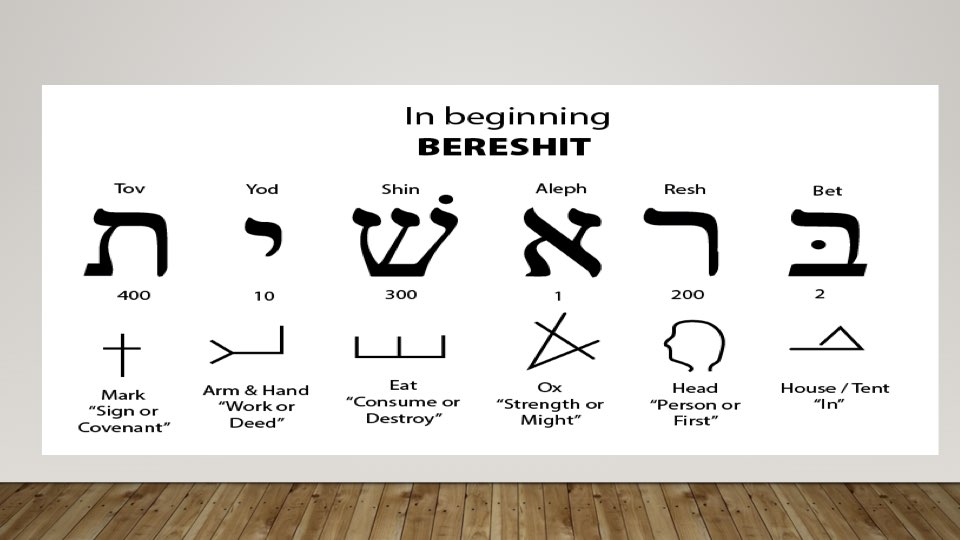
The first letter in this verse is the Hebrew letter "bet"; its symbol is that of a tent and it symbolically means "house" as well as "in". When this letter is connected to other Hebrew words it means "in". As we spoke about last session with respect to trust, betach, this is an invitation to covenant a proposal if you will. God, Abba invites us into His reality, and it is our role to accept that invitation and become His child. In natural childbirth there is no choosing. We do not choose our parents or their reality as the new agers would have us believe. No! But in our new birth it is choice that defines us eternally.
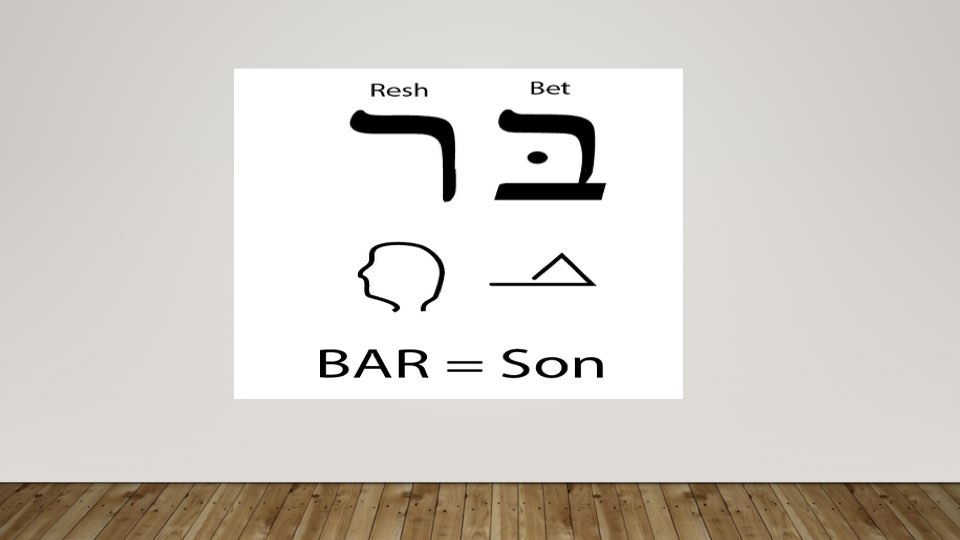
Next, we look at the first 2 letters together which is the Hebrew word “bar” which means the Son as in bar mitzvah, the son of the commandments. The letters paint the picture of an invitation into the mind of God, or alternatively that our house would be led by His thoughts. The Son of God is the one who has the mind of God and is His representation in the earth. We become this reality when we receive Yeshua as our Lord.
“Jesus said to him, "Have I been with you so long, and yet you have not known Me, Philip? He who has seen Me has seen the Father; so how can you say, 'Show us the Father'? Do you not believe that I am in the Father, and the Father in Me? The words that I speak to you I do not speak on My own authority; but the Father who dwells in Me does the works.” (Jhn 14:9-10, NKJV)
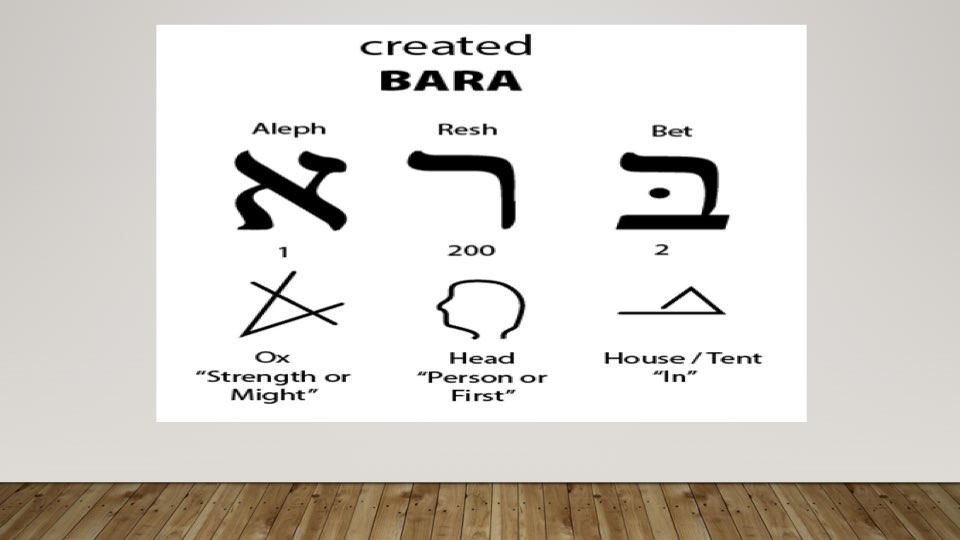
The third letter in this word is the Hebrew letter "aleph" which is the first letter of the alephbet and it has an ox head for its symbol. This letter stands for strength or might and as it is the first letter is also referring to leadership. The numerical value of this letter being the first letter is 1 and as mentioned before this letter represents God. It is also the first letter in many of the various Biblical Hebrew words for God, such as Elohim, Adonai, El, Eh-yeh etc. Deut. 6:4 tells us the "Lord is one" this directly works with this letter representing God as it's numerical value also is 1. So then the first three letters of this verse, the first three letters of the Bible reveal to the reader the "son of God". So God is the first letter of the Hebrew Alephbet and the"son", Jesus is the first word in the Bible. In fact the word "son" referring to Jesus is the first thing in the Hebrew "in beginning". this realization is amazing in light of what we are told in the New testament in John 1. In John 1:1 we literally read in the Greek "in beginning" (once again in the literal translation of the Greek the definite article "the" is not there) "was the word". Then In verse 14 the word becomes flesh and Jesus is revealed as "the word" that is "in beginning". And now we can make the connection and see that literally there is a word not only in the beginning of the Bible, but in the very word "in beginning" and that word is God's son, Jesus!
And if that isn't enough and you didn't get it, Jesus is symbolically also the second word of the Bible, "bara". In the Hebrew things are repeated in order to express their importance. Jesus is repeated in the first and second word of the Bible to express His importance in God's plan and purpose of this creation. Note: "bara" literally means "to fatten up" or "to fill up" in Hebrew but it is translated as "created" in the English.
The next letter is the letter “shin”, which is the picture of teeth. This means the destruction of something or someone. In this case it is telling us that the destruction is of the creator Himself as the Son.
Why is that? Well, we know it is for sin. But what is sin? Isn’t sin when we choose to exercise our freedom to choose and sell our souls to the devil? I mean we may not make a literal choice to that end but when we serve the fear of death which is an illusion, we live to survive rather than from the place of eternal life. This is the true role of death. Its role is to give contrast to life. Think of it in your own life when you have “lost” someone of something of value. You grieve the loss which is really the acknowledgement of life. Death reveals life. Death causes us to value life.
Yeshua said: “Most assuredly, I say to you, unless a grain of wheat falls into the ground and dies, it remains alone; but if it dies, it produces much grain. He who loves his life will lose it, and he who hates his life in this world will keep it for eternal life.” (Jhn 12:24-25, NKJV)
You see love is God. Not just that God is love, but that any god is who we love. If money is our god then it is where our heart is. If the fear of death is our god, then it rules all we do. If the Eternal God is our God then that perspective rules our life.
In this verse Yeshua is telling us that the love of our mortal life will keep us from eternal life. As He died to set us free from death, when we embrace His destruction then we are recreated into eternal sons and daughters.
Let’s continue. The next letter is the “yod” which is the symbol for the hand or the arm which means the source of the action. In the case of Yeshua it was God Himself who provided the sacrifice. No one is responsible for Yeshua’s death but God alone. He loved the world and gave His own Son to be destroyed because of that love.
Finally, we have the last letter the tav which is the symbol for the cross. The X that marks the place for the signature of God. God began creation with the crucifixion eons before man had yet to create it. He planned for the death of the Son to bring forth the many sons and daughters and wrote it into the first word of the Bible.
Yeshua was slain from the foundation, the first word of the Bible. Death is intrinsic to life. His death is the most powerful release of life.
Activation: As the world celebrates the birth of Yeshua let’s celebrate the real purpose to free us from the fear of death. Ask the Lord in the coming year to release you from any gods in your life that keep us from living as eternal beings. Ask God to free you from the sting of death. It has no power over you unless you give it power.
To add this web app to your homescreen, click on the "Share" icon

Then click on "Add to Home"

To add this web app to your homescreen, click on the "Share" icon
Then click on "Add to Home"
It looks like your browser doesn't natively support "Add To Homescreen", or you have disabled it (or maybe you have already added this web app to your applications?)
In any case, please check your browser options and information, thanks!
It looks like your browser doesn't natively support "Add To Homescreen", or you have disabled it (or maybe you have already added this web app to your applications?)
In any case, please check your browser options and information, thanks!
