
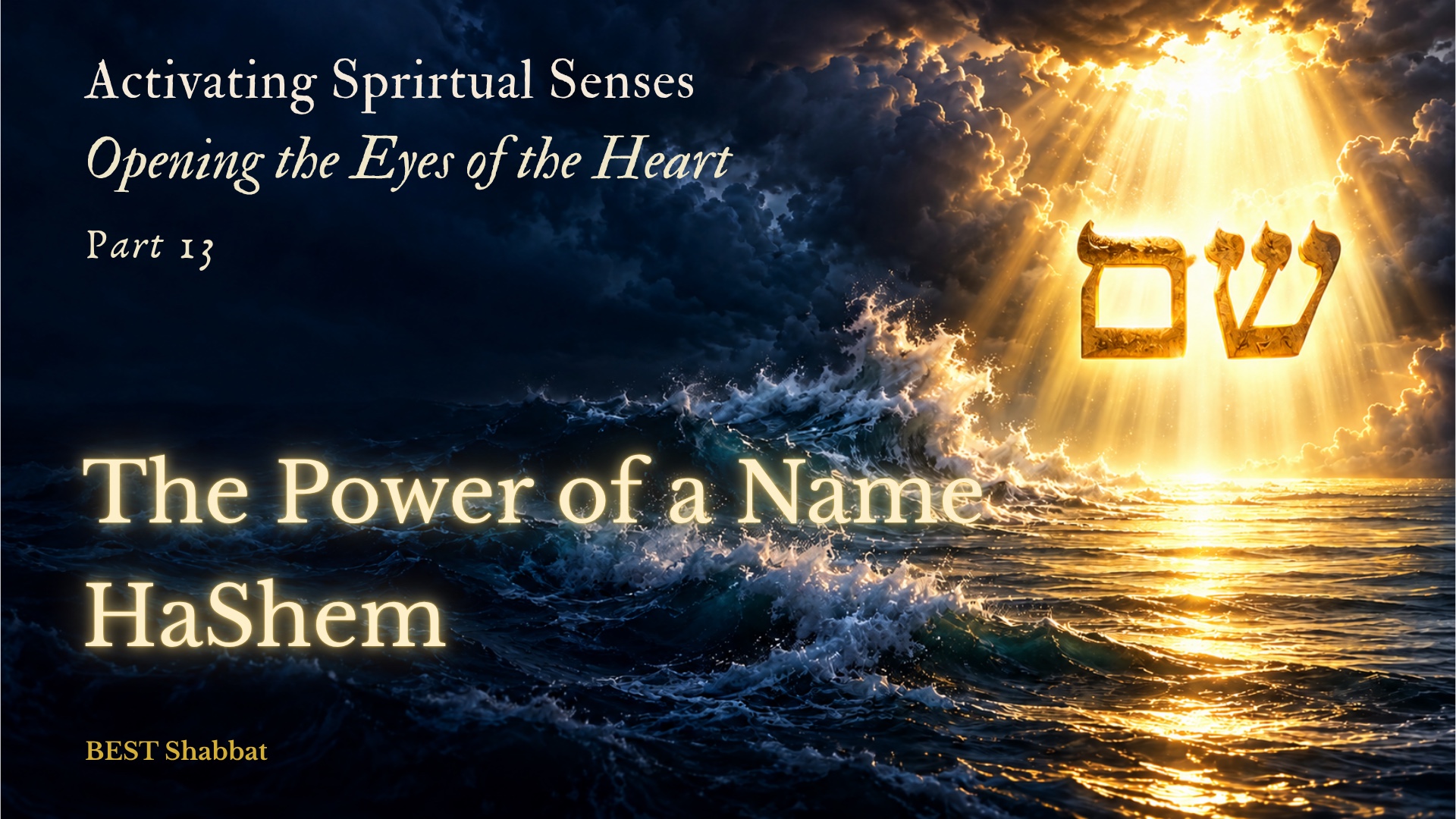
Activating Spiritual Senses: The Power of a Name HaShem
Opening the eyes of the heart - Part 13
Listen to The Power of a Name HaShem
BEST Shabbat: The Power of a Name, HaShem.
“Now the LORD said to Abram, “Go from your country, And from your relatives And from your father’s house, To the land which I will show you; And I will make you into a great nation, And I will bless you, And make your name great; And you shall be a blessing; And I will bless those who bless you, And the one who curses you I will curse. And in you all the families of the earth will be blessed.”” (Gen 12:1-3, NASB)
Naming is a powerful attribute of reality. A name carries destiny and authority, purpose and manifestation of God’s calling. The first use of names is when Adam named all of the animals.
“And out of the ground the LORD God formed every animal of the field and every bird of the sky, and brought them to the man to see what he would call them; and whatever the man called a living creature, that was its name. The man gave names to all the livestock, and to the birds of the sky, and to every animal of the field, but for Adam there was not found a helper suitable for him.” (Gen 2:19-20, NASB)
So, what’s in a name?
Paleo-Hebrew Letter Meanings
Shin (ש): Originally represented a picture of teeth. In ancient Hebrew word pictures, it can symbolize pressing, consuming, or destroying (as in tearing food with teeth).
Mem (מ): Originally represented a picture of water or liquid waves. It can symbolize chaos, mass, or flowing movement.
Combined Meaning
Literal Translation: Shem translates to "name," "renown," "reputation," or “character".
Ancient Pictographic Meaning: Combined, Shin and Mem trace a concept of the "consuming/destroying force" or "authority that overcomes chaos", or an individual's essential identity, breath, and standing (neshemah).
When a man and a woman join in covenant usually they will adopt a new name together. We introduce them as Mr. And Mrs. Whatever the last name is they have chosen to be their married by, or covenant name. This is called becoming one flesh, basal chad. Last chapter we looked at the oneness. Oneness is embodied in a name.
We have a concept known as power of attorney. A power of attorney is a legal document that gives someone else the authority to act on your behalf in certain matters. This person is known as your “agent.”
Depending on the type of POA, your agent might get involved in managing your finances and handling legal affairs. When a POA is used as part of advance care planning, that person may take over your medical decisions if you have diminished mental capacity due to dementia, a traumatic brain injury, or other condition.
In essence, the power of attorney is a mechanism to delegate to someone the power of your name. The name is: The core identity, reputation, or authoritative breath of a person or God.
Let’s extend this core idea to some other key Hebrew words to see some depth and engage with the power.
The Shema
Hearing the Authority: Adding Ayin (ע - eye/experience/perception). To Shama is to actively perceive, experience, and internalize a Shem (a voice, command, or name of authority).
The prayer known as the shema: “Hear, Israel! The LORD is our God, the LORD is one! “And you shall love the LORD your God with all your heart and with all your soul and with all your strength. “These words, which I am commanding you today, shall be on your heart. “And you shall repeat them diligently to your sons and speak of them when you sit in your house, when you walk on the road, when you lie down, and when you get up. “You shall also tie them as a sign to your hand, and they shall be as frontlets on your forehead. “You shall also write them on the doorposts of your house and on your gates. “Then it shall come about when the LORD your God brings you into the land that He swore to your fathers, to Abraham, Isaac, and Jacob, to give you, great and splendid cities which you did not build, and houses full of all good things which you did not fill, and carved cisterns which you did not carve out, vineyards and olive trees which you did not plant, and you eat and are satisfied, be careful that you do not forget the LORD who brought you out of the land of Egypt, out of the house of slavery. “You shall fear only the LORD your God; and you shall worship Him and swear by His name.” (Deu 6:4-13, NASB)
This tells us that to truly hear another we have to perceive who they truly are. The sounds we receive in our ears are just a possibility of truly listening, the shema. Because the Shem is inside the shema, the essential character must be perceived to truly receive the communication in a way that is intentional. The opposite to this is to listen with a judgement in our heart.
The writer of Hebrews addresses this and the impact:
“Therefore, just as the Holy Spirit says, “TODAY IF YOU HEAR HIS VOICE, DO NOT HARDEN YOUR HEARTS AS WHEN THEY PROVOKED ME, AS ON THE DAY OF TRIAL IN THE WILDERNESS, WHERE YOUR FATHERS PUT ME TO THE TEST, AND SAW MY WORKS FOR FORTY YEARS. “THEREFORE I WAS ANGRY WITH THIS GENERATION, AND SAID, ‘THEY ALWAYS GO ASTRAY IN THEIR HEART, AND THEY DID NOT KNOW MY WAYS’; AS I SWORE IN MY ANGER, ‘THEY CERTAINLY SHALL NOT ENTER MY REST.’” Take care, brothers and sisters, that there will not be in any one of you an evil, unbelieving heart that falls away from the living God. But encourage one another every day, as long as it is still called “today,” so that none of you will be hardened by the deceitfulness of sin. For we have become partakers of Christ if we keep the beginning of our commitment firm until the end, while it is said, “TODAY IF YOU HEAR HIS VOICE, DO NOT HARDEN YOUR HEARTS, AS WHEN THEY PROVOKED ME.” For who provoked Him when they had heard? Indeed, did not all those who came out of Egypt led by Moses? And with whom was He angry for forty years? Was it not with those who sinned, whose dead bodies fell in the wilderness? And to whom did He swear that they would not enter His rest, but to those who were disobedient? And so we see that they were not able to enter because of unbelief.” (Heb 3:7-19, NASB)
This is super important because many will use the name of Jesus but not really shema.
““Not everyone who says to Me, ‘Lord, Lord,’ will enter the kingdom of heaven, but the one who does the will of My Father who is in heaven will enter. “Many will say to Me on that day, ‘Lord, Lord, did we not prophesy in Your name, and in Your name cast out demons, and in Your name perform many miracles?’ “And then I will declare to them, ‘I never knew you; LEAVE ME, YOU WHO PRACTICE LAWLESSNESS.’ “Therefore, everyone who hears these words of Mine, and acts on them, will be like a wise man who built his house on the rock.” (Mat 7:21-24, NASB)
Using a person’s Shem, their name without knowing their heart represents another version of the one whose name is being proclaimed. Yeshua calls this lawlessness. By using this term He is relegating His name to His Word.
“I will worship toward thy holy temple, and praise thy name for thy lovingkindness and for thy truth: for thou hast magnified thy word above all thy name.” (Psa 138:2, KJV)
The heart of shema is the Shem.
Let’s look at another word “shamar”, to guard or protect. Protecting the Authority: Adding Resh (ר - head/man/first). Shamar shifts the focus to active stewardship or guardianship. It portrays a watchman or a shepherd building a thorn hedge around a flock. In context with Shem, to Shamar means to honor and protect the name/character from being defiled, keeping it intact and held in the highest position.
Yeshua is both the Word and the shamar, the protector of the Word. This is the image He gives of Himself as the good shepherd who protects His sheep.
““But the one who enters by the door is a shepherd of the sheep. “To him the doorkeeper opens, and the sheep listen to his voice, and he calls his own sheep by name and leads them out. “When he puts all his own sheep outside, he goes ahead of them, and the sheep follow him because they know his voice. “However, a stranger they simply will not follow, but will flee from him, because they do not know the voice of strangers.”” (Jhn 10:2-5, NASB)
The shepherd protects the sheep with His voice and His name. So our name is also our protection which is why we need to guard our reputation, how we are known.
“A good name is to be more desired than great wealth; Favor is better than silver and gold.” (Pro 22:1, NASB)
One final derivative from Shem is shamayim, heavens.
Exploring Shamayim is a fantastic direction, as it perfectly builds upon the Shin-Mem (ש-מ) foundation while introducing a unique ancient concept!
The Anatomy of Shamayim (שָׁמַיִם)
In Genesis 1:1, the very first verse of the Bible introduces Shamayim (commonly translated as "heavens" or "sky"). Linguistically and pictographically, this word is universally understood through two beautiful layers: [1, 2]
Layer 1: The Parent Root + Water
The literal mechanics of the word break down into a compound thought: [1]
Sham (שָׁם): Meaning "there".
Mayim (מַיִם): The absolute plural Hebrew word for "waters". [1]
To the ancient mind, looking up at the expanse of the sky meant looking at a boundary where water was suspended. Thus, Shamayim literally translates to "There are the waters." [1]
Layer 2: The Paleo-Hebrew Picture of Authority over Chaos
When analyzing the letters through Paleo-Hebrew word pictures: [1]
Shin (ש - Teeth): Pressing, sharp, consuming, transforming power.
Mem (מ - Water): Flowing liquid, immense mass, or chaotic forces. [1]
The parent root Shem (ש-מ) represents the authority that organizes or holds back chaos (like a master’s "name" or "breath" creating boundaries). By expanding this to Shamayim, the Paleo-Hebrew letters reflect the cosmic storehouse of water—the sky holding back the chaotic waters above from flooding the earth below (mirroring Genesis 1:6–8 where God separates the waters). [1, 2]
The power of Shem, the Name is the authority over the chaos of life. Let’s finish with the revealed names of God.
Sometimes things are so obvious that they can hide for years in plain sight. One day, I realized I had been praying “Our Father, who art in Heaven, hallowed be thy name” for literally decades and had never investigated the many names of God. Each of his names carries deep significance about his nature, character, and relationship with his people. These names are not just titles, but powerful declarations of who he is.
“Let them praise the name of the Lord, for his name alone is exalted; his splendor is above the earth and the heavens.” Psalm 148:13
1. YHWH (YAHWEH) – THE SELF-EXISTENT ONE
YHWH (often written as Yahweh or Jehovah) is the most sacred name of God in the Bible. It means “I AM WHO I AM” (Exodus 3:14), emphasizing his eternal and unchanging nature. This name signifies God’s self-existence and sovereignty.
Life Application: Call on God’s personal, covenant-keeping name in prayer, knowing he’s always near and faithful to his promises.
2. ELOHIM – THE MIGHTY CREATOR
Elohim is the first name of God mentioned in the Bible (Genesis 1:1). It means “God” in the plural form, highlighting his power, majesty, and role as the Creator of the universe.
Life Application: Marvel at God’s creative power in nature and in your life, finding purpose in his design.
3. EL SHADDAI – LORD GOD ALMIGHTY
This name, meaning “Lord God Almighty” or “The All-Sufficient One,” appears in Genesis 17:1 when God reaffirms his covenant with Abraham. It speaks of God’s limitless power and ability to provide for his people.
Life Application: When you feel overwhelmed by life’s challenges, trust in God’s all-powerful nature to sustain and strengthen you through tough times.
4. EL ELYON – THE MOST HIGH GOD
El Elyon, meaning Most High God, refers to God’s omnipotence, holiness, and gracious nature, as seen in Deuteronomy 26:19, “He has declared that he will set you in praise, fame and honor high above all the nations he has made and that you will be a people holy to the Lord your God, as he promised.”
Life Application: In moments of doubt or confusion, look to the one who reigns above all to guide your decisions with ultimate wisdom.
5. EL OLAM – THE EVERLASTING GOD
In Genesis 21:33, Abraham calls on the LORD as El Olam. This name is a declaration of God’s eternal and unchanging nature, without beginning or end.
Life Application: Anchor your hope in God’s eternal nature when life feels fleeting or uncertain.
6. QANNA – JEALOUS
Qanna is used in the first commandment, depicting a marital relationship between himself and believers. God desires all of our praise for himself and no one else. (Exodus 34:14)
Life Application: Prioritize God above all else, knowing his jealous love desires your whole heart.
7. ADONAI – THE LORD AND MASTER
Adonai means “Lord” or “Master” and is used when acknowledging God’s authority and dominion. Found in Genesis 15:2, this name signifies submission and reverence to God’s rule over all things.
Life Application: Surrender your plans to God’s leadership, finding freedom in obeying him as the one who rightfully guides your path.
8. YAHWEH JIREH – THE LORD WILL PROVIDE
First mentioned in Genesis 22:14 when God provided a ram for Abraham instead of Isaac, Jehovah Jireh highlights God as our provider, meeting our needs in perfect timing.
Life Application: When needs arise, trust God to provide just what you need, right when you need it.
9. YAHWEH RAPHA – THE LORD WHO HEALS
Found in Exodus 15:26, this name declares God as our healer—physically, spiritually, and emotionally. It reflects his desire to restore and renew his people.
Life Application: Seek God’s healing touch for your hurts—whether physical, emotional, or spiritual—and rest in his restoring power.
10. YAHWEH NISSI – THE LORD IS MY BANNER
Used in Exodus 17:15 after Israel’s victory over Amalek, Jehovah Nissi symbolizes God’s protection, guidance, and victory over the enemy.
Life Application: When facing battles—emotional or physical—rally under God’s banner for victory and identity in his protection.
11. YAHWEH SHALOM – THE LORD IS PEACE
In Judges 6:24, Gideon calls God “Jehovah Shalom” after encountering him. This name reassures us that God is the source of true peace, even in the midst of chaos.
Life Application: In chaos or stress, turn to God for the calm and peace that only he can give.
12. YAHWEH TSIDKENU – THE LORD OUR RIGHTEOUSNESS
Jeremiah 23:6 introduces this name, pointing to God as the source of our righteousness. It prophetically refers to Jesus Christ, who makes us right with God through his sacrifice.
Life Application: When guilt weighs you down, lean on God’s righteousness to forgive and renew your sense of worth.
13. YAHWEH SHAMMAH – THE LORD IS THERE
In Ezekiel 48:35, this name signifies God’s presence with his people. It reminds us that God is near, dwelling among his people and never abandoning them.
Life Application: When you feel alone, remember God’s constant presence is with you, bringing comfort in every situation.
14. YAHWEH-RAAH – THE LORD MY SHEPHERD
This name is a metaphor that describes God’s relationship with his followers, the believers. It highlights the intimate relationship God desires with us, as evidenced in Psalm 23.
Life Application: Let God guide you like a shepherd when you’re lost, trusting he’ll lead you to peace and provision.
15. YAHWEH MEKODDISHKEM – THE LORD WHO SANCTIFIES YOU
Found in Exodus 31:13, Jehovah Mekoddishkem occurs in a passage urging believers to keep the Sabbath and emphasizing the fact that holiness comes from the Lord.
Life Application: Pursue growth and holiness, trusting God to shape you into who He created you to be.
16. YAHWEH SABAOTH – THE LORD OF HOSTS
The name Yahweh Sabaoth denotes a military context and signifies God’s sovereignty over all armies, both spiritual and earthly. As the God of angel armies, this name highlights God’s role as a warrior who fights for his people Israel and against divine forces. This is the name David used in 1 Samuel 17:45, when he said. “You come against me with sword and spear and javelin, but I come against you in the name of the Lord Almighty, the God of the armies of Israel, whom you have defied.”
Life Application: When you feel powerless, rely on God’s command over all forces—seen and unseen—to fight for you.
FINAL THOUGHTS
Each of these names reveals a unique aspect of God’s character and his relationship with us. Whether you need provision, healing, peace, or righteousness, God’s name assures us that he is everything we need.
My prayer life has exponentially deepened as I intentionally call on God’s names to reflect my needs and his character. For example, one can cry out to El Shaddai for strength in weakness, seek Yahweh Jireh for provision in scarcity, or praise El Olam for hope amid change.
Using Yahweh Rapha can invite healing, while Yahweh Shalom can anchor prayers for peace. By aligning each name with specific situations—thanking Yahweh Nissi for victory or asking Yahweh-Raah for guidance—prayers become personal, focused, and rooted in God’s multifaceted nature.
Activation Honoring His Name
Choose one revealed name of God. Select the name that most directly speaks to your present need or season.
Read its Scripture aloud. Let the biblical passage define God’s character instead of relying only on your circumstances or emotions.
Pray with understanding. Address God by that revealed name and thank Him for the aspect of His nature it declares.
Listen and respond. Ask how honoring His name should change your thoughts, words, decisions, or relationships today.
Guard the name. Carry His character faithfully by choosing an action that agrees with what you have heard.
Related


To add this web app to your homescreen, click on the "Share" icon

Then click on "Add to Home"

To add this web app to your homescreen, click on the "Share" icon
Then click on "Add to Home"
It looks like your browser doesn't natively support "Add To Homescreen", or you have disabled it (or maybe you have already added this web app to your applications?)
In any case, please check your browser options and information, thanks!
It looks like your browser doesn't natively support "Add To Homescreen", or you have disabled it (or maybe you have already added this web app to your applications?)
In any case, please check your browser options and information, thanks!