
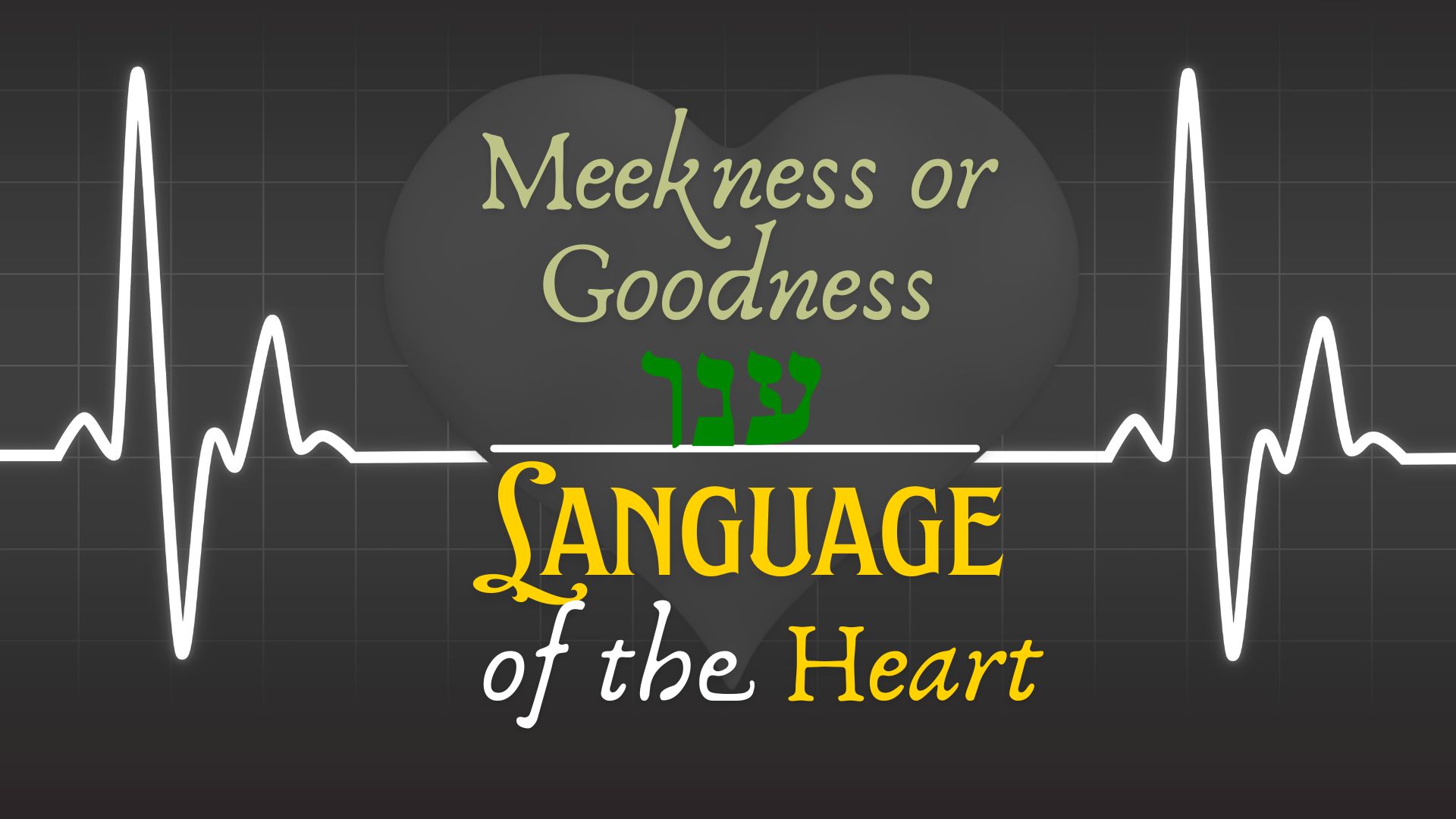
The Language of The Heart: Meekness or Gentleness - ענו
“But the fruit of the Spirit is love, joy, peace, patience, kindness, goodness, faithfulness, gentleness, self-control; against such things there is no law.” (Gal 5:22-23, NASB)
The fruit of the Spirit are clearly the result of the manifest Presence of the Holy Spirit in and through a Believer’s life. The parable of the sower gives us an insight into our part in manifesting the fruit. If they were automatic to being a Believer then I don’t think Yeshua would have spoken about the soil of the heart as conditions for fruitfulness.
Looking back to Mark 4 we see 4 conditions that are our responsibility to manifest fruit in our lives.
First, let look at context:
“And He was saying to them, “To you has been given the mystery of the kingdom of God, but for those who are outside, everything comes in parables, so that WHILE SEEING THEY MAY SEE, AND NOT PERCEIVE, AND WHILE HEARING, THEY MAY HEAR, AND NOT UNDERSTAND, OTHERWISE THEY MIGHT RETURN AND IT WOULD BE FORGIVEN THEM.” And He *said to them, “Do you not understand this parable? How will you understand all the parables?” (Mrk 4:11-13, NASB)
Yeshua is making a distinction between disciples who receive the “mystery of the kingdom” and those on the outside who have not yet received the Lord and thus are in on the mystery. The distinction produces seeing without perceiving, hearing but not understanding and most importantly not repenting and receiving forgiveness. Obviously, the fruit of the Spirit is not possible without the indwelling Spirit.
He then goes on the explain the 4 heart conditions.
- “These are the ones who are beside the road where the word is sown; and when they hear, immediately Satan comes and takes away the word which has been sown in them.” (Mrk 4:15, NASB)
- “And in a similar way these are the ones sown with seed on the rocky places, who, when they hear the word, immediately receive it with joy; and yet they have no firm root in themselves, but are only temporary; then, when affliction or persecution occurs because of the word, immediately they fall away.” (Mrk 4:16-17, NASB)
- “And others are the ones sown with seed among the thorns; these are the ones who have heard the word, but the worries of the world, and the deceitfulness of wealth, and the desires for other things enter and choke the word, and it becomes unfruitful.” (Mrk 4:18-19, NASB)
- “And those are the ones sown with seed on the good soil; and they hear the word and accept it and bear fruit, thirty, sixty, and a hundred times as much.”” (Mrk 4:20, NASB)
The first 3 heart conditions don’t bear fruit of the Spirit. The 4th does, 30-60-100fold. The key condition is hearing, accepting, and then bearing. This tells us that how we listen and how we receive impacts the fruit of the Spirit in our lives.
This tells me that God’s Word spoken to our hearts is the seed carrier and our role is to identify and the accept it. We are encouraged to tune ourselves to be able to hear accept and bear fruit.
God’s voice carries His Spiritual fruit in the communication. Yeshua called this “all truth”.
“But when He, the Spirit of truth, comes, He will guide you into all the truth; for He will not speak on His own, but whatever He hears, He will speak; and He will disclose to you what is to come.” (John 16:13, NASB)
He is the “Spirit of Truth”. The fruit of the Spirit are the fruits of truth. This is described as “what is to come”. Like a fruit tree with a tag to identify what is to come, as we meditate of the truth, we prepare our hearts to listen to the truth, accept it and bear the fruit of truth.
One of the fruits of truth is the fruit of meekness or gentleness. This one is listed right before self-control which could tell us that it requires us to sow the seed in our own heart to manifest true meekness or gentleness. Why is it worth doing?
Because Yeshua tells us it is a power key to our destiny.
“Blessed are the meek: for they shall inherit the earth.” (Mat 5:5, KJV)
Our inheritance is released by the fruit of meekness which we bear when we listen for meekness and then accept it or come into agreement with that voice of truth. We have an inheritance but we need to learn the terms of the last willful and testament of the Lord for manifesting or acquiring and living out that inheritance.
“that the God of our Lord Jesus Christ, the Father of glory, may give to you the spirit of wisdom and revelation in the knowledge of Him, the eyes of your understanding being enlightened; that you may know what is the hope of His calling, what are the riches of the glory of His inheritance in the saints,” (Eph 1:17-18, NKJV)
Clearly, from this verse, it seems that we need to be enlightened in the “eyes of our heart” that we might hope for our inheritance. Part of this process is seeding the spirit seed into our hearts and awakening to the character being His children to walk out our inheritance. The “eyes of our heart” might be some spiritual ability, but also might be the perspective we bring to what is seeded in our heart. We need to “see” ourselves as meek.
This might seem easy but meekness is NOT easy. It may be the most difficult spirit-seed we desperately need in these perilous times. Let’s dive deeply into it.
The first use in the bible is spoken of as a quality of Moses when he is challenged as being the one who is qualifiedly his brother and sister, Aaron and Miriam, to lead Israel out of captivity into their destiny. His destiny seed is the seed for all of Israel.
“And Miriam and Aaron spake against Moses because of the Ethiopian woman whom he had married: for he had married an Ethiopian woman. And they said, Hath the LORD indeed spoken only by Moses? hath he not spoken also by us? And the LORD heard it. (Now the man Moses was very meek, above all the men which were upon the face of the earth.)” (Num 12:1-3, KJV)
The word translate as meek is also translated as humble. What is the word and what does the word picture show us?
The ancient Hebrew word picture for meekness, based on the root anah (ענה) or anav (ענו), is the picture of "an eye watching" (Ayin) or "strength under control/tamed," representing a humble, dependent, and disciplined life. It signifies a person who is "brought low" (afflicted) yet remains faithful, relying on God rather than self-assertion.
Key Components of the Hebrew Word Picture:
The Eye (Ayin - ע): The first letter in anah represents an eye, symbolizing how meekness is about where one places their focus—on God rather than themselves. It involves being attentive, watching one’s own heart, and being teachable.
Tamed Strength: Similar to a wild animal that has been broken and disciplined, biblical meekness is not weakness, but rather tremendous strength that is submitted, controlled, and quiet, as seen in the life of Moses.
Lowly/Afflicted (Anav - ענו): The word indicates someone who has been humbled by circumstances but maintains a deep, quiet trust in God's, allowing him to act on their behalf.
Biblical Example:
Moses is described as the most anav (meek) person on earth, not because he was timid, but because he was entirely surrendered to God's authority, even while holding great power.
The Hebrew word is also used for a furrow, a deeper place, which gives us the sense of intense focus like a furrow in the forehead. It also is a place of lowliness, a yielding of power.
Another image is of the lioness who has tremendous power but treats her cubs with gentleness.
Meekness implies that we have the power to do certain things but we purposely limit ourselves to honor God.
As an example, we have our whole income but we chose to limit ourselves by tithing. Alternatively, we could exact revenge against someone who has wronged us but we limit ourselves to honor God by forgiving the offense.
This is why meekness, or gentleness is the doorway to our destiny in God. Let’s look at the example of Yeshua:
“Let this mind be in you, which was also in Christ Jesus: Who, being in the form of God, thought it not robbery to be equal with God: But made himself of no reputation, and took upon him the form of a servant, and was made in the likeness of men: And being found in fashion as a man, he humbled himself, and became obedient unto death, even the death of the cross.” (Php 2:5-8, KJV)
All the power and authority of God yet humbled Himself to become a man and one who died on the cross. The result?
“Wherefore God also has highly exalted him, and given him a name which is above every name: That at the name of Jesus every knee should bow, of things in heaven, and things in earth, and things under the earth; And that every tongue should confess that Jesus Christ is Lord, to the glory of God the Father.” (Php 2:9-11, KJV)
Now we see the pattern, meekness and destiny.
Let’s look a few other verses to grasp the nature and power of meekness.
“The meek will he guide in judgment: and the meek will he teach his way.” (Psa 25:9, KJV)
Wow! He requires us to be meek to be able to judge the truth, to learn His ways. Why is that? Because the opposite of being meek is living beyond His boundaries and doing whatever we think we deserve to do. It is the attitude of arrogance that led the way for Satan.
Let’s look at another verse:
“The meek also shall increase their joy in the LORD, and the poor among men shall rejoice in the Holy One of Israel.” (Isa 29:19, KJV)
Meekness is a power key to joy! You see when we yield our power to His power we leave the realm of trusting in ourselves which produces nothing but anxiety. To really enter into the joy of the Lord which is the place of true power we need to walk in meekness.
One final verse:
“The Spirit of the Lord GOD is upon me; because the LORD has anointed me to preach good tidings unto the meek; he hath sent me to bind up the brokenhearted, to proclaim liberty to the captives, and the opening of the prison to them that are bound;” (Isa 61:1, KJV)
Good tidings, the goodness of God is preached to the meek. This is more than the plan of salvation it is all of the good things of the Lord and of His kingdom. You see we cannot out give God. We cannot yield enough because He always gives us abundantly above anything we surrender to Him. This is the power key of meekness which opens up our miracles.
The opposite of meekness is control, the need to call the shots. We see this in the story of healing of Naaman the Syrian.
“Now Naaman, commander of the army of the king of Syria, was a great and honorable man in the eyes of his master, because by him the LORD had given victory to Syria. He was also a mighty man of valor, but a leper. And the Syrians had gone out on raids, and had brought back captive a young girl from the land of Israel. She waited on Naaman's wife. Then she said to her mistress, "If only my master were with the prophet who is in Samaria! For he would heal him of his leprosy."” (2Ki 5:1-3, NKJV)
The prophet Elisha responded but it required some humility on naaman’s part:
“Then Naaman went with his horses and chariot, and he stood at the door of Elisha's house. And Elisha sent a messenger to him, saying, "Go and wash in the Jordan seven times, and your flesh shall be restored to you, and you shall be clean." But Naaman became furious, and went away and said, "Indeed, I said to myself, 'He will surely come out to me, and stand and call on the name of the LORD his God, and wave his hand over the place, and heal the leprosy.'” (2Ki 5:9-11, NKJV)
Naaman wanted the healing but he wanted it his way. This is so true of many of the things that God wants to do but our ideas of what it will look like is really all about our need to be in control. Good news for Naaman he does eventually humble himself and receives his healing,
“And his servants came near and spoke to him, and said, "My father, if the prophet had told you to do something great, would you not have done it? How much more then, when he says to you, 'Wash, and be clean'?" So he went down and dipped seven times in the Jordan, according to the saying of the man of God; and his flesh was restored like the flesh of a little child, and he was clean.” (2Ki 5:13-14, NKJV)
Activation: Ask the Lord what have you been controlling that you need to release to Him?
Related

To add this web app to your homescreen, click on the "Share" icon

Then click on "Add to Home"

To add this web app to your homescreen, click on the "Share" icon
Then click on "Add to Home"
It looks like your browser doesn't natively support "Add To Homescreen", or you have disabled it (or maybe you have already added this web app to your applications?)
In any case, please check your browser options and information, thanks!
It looks like your browser doesn't natively support "Add To Homescreen", or you have disabled it (or maybe you have already added this web app to your applications?)
In any case, please check your browser options and information, thanks!

Comments for