
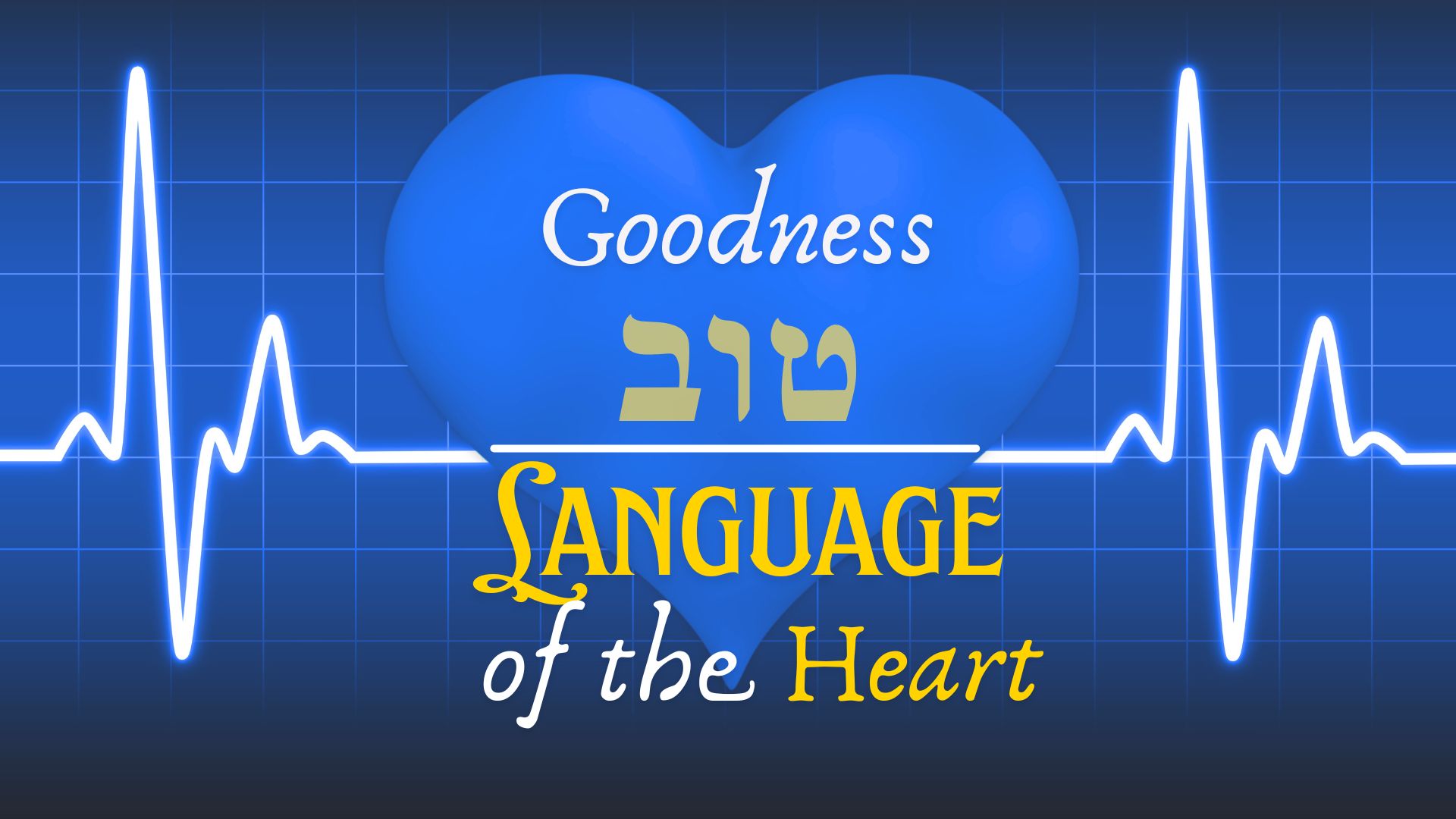
The Language of The Heart, Goodness טוֹב
“And the axe is already laid at the root of the trees; therefore, every tree that does not bear good fruit is being cut down and thrown into the fire.” (Mat 3:10, NASB)
We have been looking at how the fruit of the Spirit reflects the atmosphere of the language of the heart. The fruit of the spirit are defined as:
“But the fruit of the Spirit is love, joy, peace, patience, kindness, goodness, faithfulness, gentleness, self-control; against such things there is no law.” (Gal 5:22-23, NASB)
What does Paul mean when he says that against the fruit of the Spirit there is no law? I think what he is saying is that the law, the Torah, reveals what of our behavior or thinking is contrary to God. He says:
“because by the works of the Law none of mankind will be justified in His sight; for through the Law comes knowledge of sin.” (Rom 3:20, NASB)
The “law” or torah reveals sin by presenting its opposite. Yeshua taught us that it remains irrefutable as an eternal standard, revealing God’s will and nature, and is embedded into reality.
““Do not presume that I came to abolish the Law or the Prophets; I did not come to abolish, but to fulfill. “For truly I say to you, until heaven and earth pass away, not the smallest letter or stroke of a letter shall pass from the Law, until all is accomplished! “Therefore, whoever nullifies one of the least of these commandments, and teaches others to do the same, shall be called least in the kingdom of heaven; but whoever keeps and teaches them, he shall be called great in the kingdom of heaven. “For I say to you that unless your righteousness far surpasses that of the scribes and Pharisees, you will not enter the kingdom of heaven.” (Mat 5:17-20, NASB)
The “law” of God, His Torah, is established truth. It undergirds reality and reveals harmony. Similar to physical discoveries like the “law of gravity,” the laws of God are the fundamental workings of His creation.
That being the case, sin, then, at its most fundamental level, is the inner workings of our thinking and subsequent actions that are in conflict with God’s laws and produce brokenness in our lives. Yeshua taught us that it goes deeper than behaviors or mistakes of action. It goes to the very thinking that precedes the action.
“You have heard that it was said, ‘YOU SHALL NOT COMMIT ADULTERY’; but I say to you that everyone who looks at a woman with lust for her has already committed adultery with her in his heart.” (Mat 5:27-28, NASB)
This tells us that we all need a heart transformation, not just good works. The question then is, what do we need our heart transformed into? I want to suggest it is into a good heart.
You may think this is impossible, but Yeshua says otherwise:
“For there is no good tree that bears bad fruit, nor, on the other hand, a bad tree that bears good fruit. “For each tree is known by its own fruit. For people do not gather figs from thorns, nor do they pick grapes from a briar bush. “The good person out of the good treasure of his heart brings forth what is good; and the evil person out of the evil treasure brings forth what is evil; for his mouth speaks from that which fills his heart.” (Luk 6:43-45, NASB)
The key is what treasure is in our heart! Good treasure or evil treasure? What defines treasure? Values. What do we invest our resources in? Yeshua taught us:
“Again, the kingdom of heaven is like a merchant seeking fine pearls, and upon finding one pearl of great value, he went and sold everything that he had and bought it.” (Mat 13:45-46, NASB)
What is the pearl of great value? I think if we look at this parable, we can see that it was distinguished from all of the already owned pearls and was of such great value that it required the owner to sell all that he had previously valued to posses it. This tells us that the kingdom of heaven is so superior to all other kingdoms that we are required to sell them all to possess it. Kingdoms are about allegiance. Allegiance is what we give our loyalty to; our heart covenants with the kingdom. Yeshua is telling us that we have to sell all allegiances to posses His kingdom. The question is, what are allegiances based on, and why do we make them?
What is mammon truly? I think it is the fruit of wanting to be like God, in control of our lives. It is “knowing good and evil”.
“For God knows that on the day you eat from it your eyes will be opened, and you will become like God, knowing good and evil.”” (Gen 3:5, NASB)
Once we become “like God” knowing good and evil, we begin to establish kingdoms in our lives based on our perceptions of good and evil. Many times in my life, and I’m sure in yours, I have reacted to a person or a situation and determined my own sense of good and evil. In those stories, I am usually on the side of “good,” and the person who has hurt me is on the side of evil. This puts me in the place of God judging good and evil, and in turn judges me.
“Do not judge, so that you will not be judged. “For in the way you judge, you will be judged; and by your standard of measure, it will be measured to you.” (Mat 7:1-2, NASB)
This is the trap of the power structures that are built on the deceit of riches, our own values or pearls in our lives that must be sold to find the true pearl of great value.
“And others are the ones sown with seed among the thorns; these are the ones who have heard the word, but the worries of the world, and the deceitfulness of wealth, and the desires for other things enter and choke the word, and it becomes unfruitful.” (Mrk 4:18-19, NASB)
The only true pearl is the pearl of God’s goodness. In Hebrew, the word is “tov”
In Ancient Hebrew (Paleo-Hebrew), the word for "good" is Tov (טוב). It is composed of three pictographic letters, each conveying a concrete meaning that, when combined, forms a "word picture" of something functioning properly or being in order.
The Letters of "Tov" (טוב)
-
Tet (ט): Originally pictured as a basket or a container (sometimes interpreted as something twisted or coiled like a clay pot). It represents surrounding, containing, or storing what is valuable.
-
Vav (ו): Pictured as a tent peg or a nail. It carries the meaning of securing, connecting, or establishing.
-
Bet (ב): Pictured as a house or the floor plan of a tent. It represents the household, family, or the inside of a dwelling.
The Word Picture
When combined, these pictographs describe "good" as:
"The basket (Tet) that secures (Vav) the house (Bet)."
In ancient thought, "good" was not an abstract feeling but a functional reality. A "good" house was one that was orderly, secure, and contained everything necessary for life to flourish.
This emphasizes the thinking that when we build a home, we do it to nurture those who are being raised in that home to experience goodness.
We see this played out in the Genesis creation account. As God, the creator, builds His house for us, His children, He declares each section “tov” good. At the end of the 6th day, He declared:
“And God saw all that He had made, and behold, it was very good. And there was evening and there was morning, the sixth day.” (Gen 1:31, NASB)
This tells us that goodness is an anchor for creation. We are called for goodness. We are designed to build good homes and a good environment for the treasures in our lives, our families, our friendships.
Yeshua described His ascension as this very process.
“In My Father’s house are many rooms; if that were not so, I would have told you, because I am going there to prepare a place for you. “And if I go and prepare a place for you, I am coming again and will take you to Myself, so that where I am, there you also will be.” (Jhn 14:2-3, NASB)
This is the picture of goodness! Yeshua, as the bridegroom, is bringing His bride to a home built on the goodness of God.
Goodness is what draws us to God. As we draw near, His goodness radiates into our being.
“For, behold, those who are far from You will perish; You have destroyed all those who are unfaithful to You. But as for me, the nearness of God is good for me; I have made the Lord GOD my refuge, So that I may tell of all Your works.” (Psa 73:27-28, NASB)
This is the power behind our testimony. When we share our testimony, what we are actually recounting is our intersection with the goodness of God, which overcomes the power of the devil.
Goodness overcomes evil. There is only one pure "Good Being," and that is God.
“But Jesus said to him, “Why do you call Me good? No one is good except God alone.” (Luk 18:19, NASB)
This verse has always been an interesting one. Yeshua, who seemed good by all the standards that could be applied, refused to be called good. Why is that?
I think the answer is that in order to die, He had to allow the law of sin and death to reign in His mortal body. His death fulfilled that law. Even though the scripture tells us that He was without sin, He still paid the price for sin. This means that He could become sin and die.
“He made Him who knew no sin to be sin in our behalf, so that we might become the righteousness of God in Him.” (2Co 5:21, NASB)
What did it mean for Him to become sin? I think it meant for Him to become a human who partook of the tree of the knowledge of good and evil. Therefore He could die. The Law of sin and death could operate in and on Him. Because of that He did not claim to be good. Only God the Father, who lived beyond sin and death, could truly be good.
Once Yeshua died and resurrected, He could ascend back to the realm of no sin, the realm of goodness. I believe this is why He wouldn’t let Mary Magdalene cling to Him until He ascended to goodness, to the realm of God.
“Jesus *said to her, “Stop clinging to Me, for I have not yet ascended to the Father; but go to My brothers and say to them, ‘I am ascending to My Father and your Father, and My God and your God.’”” (Jhn 20:17, NASB)
He had resurrected but not been eternally cleansed by goodness.
Let’s look at some manifestations of goodness.
Sometimes we are so close to something we cannot see it. Similar to the prodigal son we need to eat the slop of the world and experience the poison to goodness
Take this community, for example
We are building a house to show God's goodness
Or look at Destiny House, which is receiving our first women in a week
What is the goal? For goodness to be manifested
Today is a workday, and we have a team on the 19th who will be here for 3 days to help build out the educational wing for Destiny House.
Activation: I want to challenge you to up your goodness. Part give and plan on coming to the Evening of Destiny in the fall. Destiny House is the embodiment of God’s goodness.
Related

To add this web app to your homescreen, click on the "Share" icon

Then click on "Add to Home"

To add this web app to your homescreen, click on the "Share" icon
Then click on "Add to Home"
It looks like your browser doesn't natively support "Add To Homescreen", or you have disabled it (or maybe you have already added this web app to your applications?)
In any case, please check your browser options and information, thanks!
It looks like your browser doesn't natively support "Add To Homescreen", or you have disabled it (or maybe you have already added this web app to your applications?)
In any case, please check your browser options and information, thanks!

Comments for