
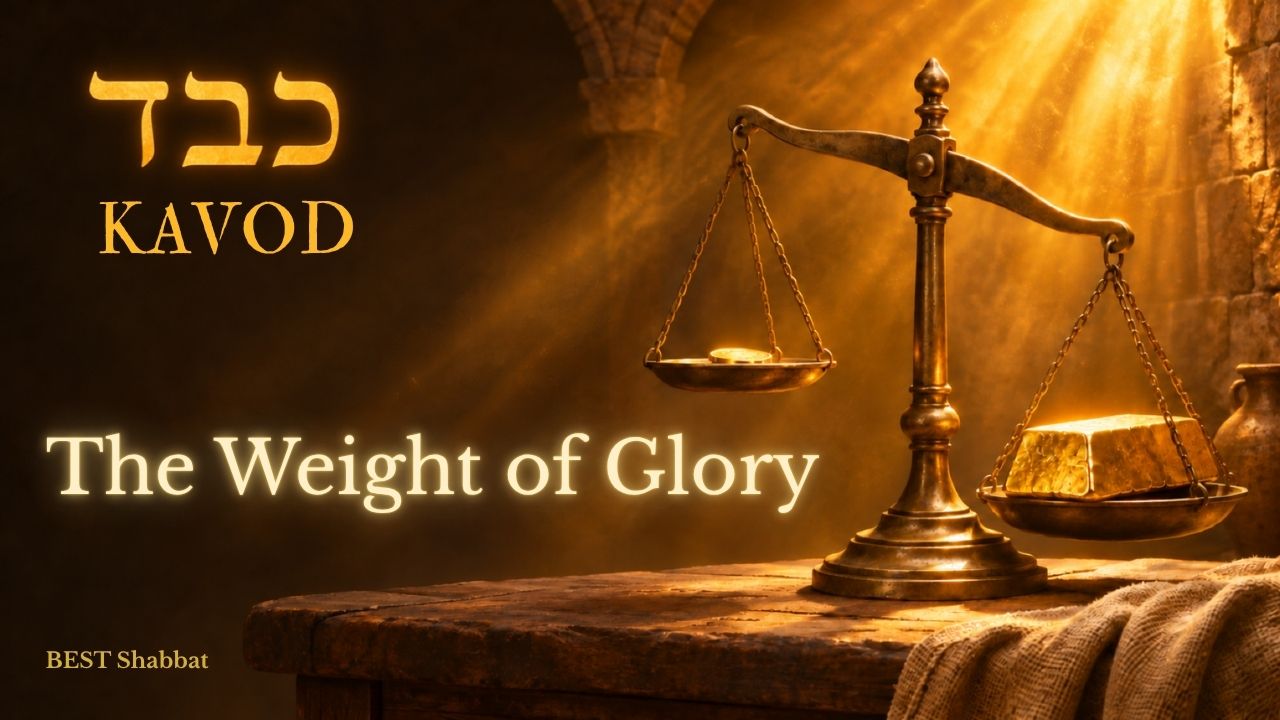
Kavod: The Weight of Glory
Listen to Kavod: The Weight of Glory
“And the glory which You gave Me I have given them, that they may be one just as We are one:” (Jhn 17:22, NKJV)
Today, we are going to dive into another Hebrew Word and its picture to illuminate the walk of faith in our lives. This is the word Kavod or Glory.
Picture an old merchant at his table with a small brass balance. A young man sets down a coin, polished until it throws the lamplight around the room, and waits to be praised for it. The merchant does not even look at the shine. He sets the coin on the scale, watches the arm settle, and reads the only thing that matters to him: how much does it actually weigh? Shine can be faked with a rag and some spit. Weight cannot. Weight is the metal that is really there.
Watch that same merchant a little longer and you will see the whole ancient economy turning on his patience. There were no minted, guaranteed coins in the oldest markets — a man paid in cut silver, in rings and broken pieces, and the only honest question in any deal was the weight. A crook could hammer a coin thin, plate a lead slug in gold, shave the edges of an honest piece and pocket the difference. None of it survived the scale. That is why the Torah keeps returning, almost fiercely, to the demand for honest weights — a true stone in the bag, a balance that does not lie. In a world where everything could be counterfeited except mass, weight became the very picture of what is real. The scale was where truth was told.
That balance arm is the whole idea of kavod. Not the glitter. The heft.
You have probably always heard that kavod means "glory," and you picture glory as brightness — a dazzle of light, applause, a famous name, a reputation that sparkles. So, we chase the sparkle, the recognition and we call the sparkle glory.
But the Hebrew runs the other direction. Kavod comes from a root that means heavy, weighty, substantial, of real worth.
Glory is not the flash on the surface; it is the mass underneath. When Scripture says the kavod of Yahweh filled the temple, it does not mean the room got shiny. It means His presence became so weighty, so utterly there, that the priests could not stand up under it. Glory is what has substance. It is the difference between gold leaf and a bar of gold.
The picture behind the letters
Hebrew began as pictures. Every letter was once a little drawing, and the drawings still carry their meaning under the sound.
Paleo-Hebrew infographic Kavod
Look at what the letters were:
- Kaf (כ) — an open palm, bent to press down or to bear a load. It is the hand that carries the heavy thing. Your strength of character determines the load you can bear.
- Bet (ב) — a house or tent. The dwelling, the household, the space that gets filled. The dwelling place of God.
- Dalet (ד) — a door. The threshold, the way in and the way out. Access to the Kavod.
Read them like a little sentence and kavod almost tells its own story: a weight so great it is pressed down (kaf) into the house (bet) until it fills every room and presses out the door (dalet).
“The word picture says that when I treat someone with great value that the honor given is What Opens the Inside Door.”
Great Value is judged by Weight. What we consider important, or respect, we Honor, or Glorify:
“Honor (כָּבַד Kavad) your father and your mother, that your days may be long in the land that יְהוָֹה YHVH your God is giving you. Exodus 20:12
That is exactly the picture of the glory that filled the tabernacle — a presence with so much mass it could not be contained, spilling to the threshold and beyond. Glory is weight that fills a room.
The family born from a heavy root
Once you feel the weight in kavod, you start to hear it echoing through a whole family of Hebrew words, all grown from the same three-letter root — kaf, bet, dalet — and every one of them is heavy in some way.
- The same root gives kaved, the liver — the heaviest, densest organ in the body, dark and blood-rich, which the ancients felt was the very seat of a person's inner substance. When an old poet said he would praise God "with my liver," he was not being crude; he was reaching for the weightiest, most solid part of himself.
- The root gives koved, sheer heaviness or a burden, the load that presses on the shoulders.
- It gives the adjective kaved meaning hard, severe, grievous — a heavy famine, a heavy hand, a heavy heart. Pharaoh's heart was kaved, hardened and heavy, so weighted down against Yahweh that it could not be moved.
- There is even a tender surprise in the poetry: the old singers sometimes used kavod to mean the inmost self, the soul. When a psalm cries "awake, my kavod, awake!" it is not rousing a reputation — it is calling the deepest, weightiest part of a person up out of sleep to sing. Your kavod, in that usage, is the real you, the substantial core under the surface of a life, the part with actual mass. It is a quietly beautiful thing to learn that the word for glory is also a word for the true inner self, as if to say: the weightiest thing about you is not your shine either, but the soul that is really there.
- And most beautifully, the root gives the verb kabed, "to honor," which literally means "to make heavy." Sit with that a moment, because it changes everything. When we are commanded to honor a father and mother, the word is not asking for a warm feeling or a polite nod. It is asking us to give them weight — to treat them as substantial, as people who genuinely matter, whose lives are allowed to press on ours. To honor someone is to let them count.
And its opposite, in Hebrew, is telling: to dishonor, to hold in contempt, is kalal — from a root meaning light, slight, trivial. To despise a person is literally to treat them as lightweight, to feel them as air. We “make light” of someone’s words when we give them no honor. So the whole moral vocabulary sorts itself along the scale: what you honor, you let weigh on you; what you scorn, you treat as weightless. Glory and honor and heaviness are all one thing seen from different sides.
Where the word lives in Scripture
Follow kavod across the Scriptures and you watch it grow from a merchant's scale into the deepest hope of a whole people.
- It shows up first as plain, tangible wealth. When we read that Abraham was "heavy" — kaved — in livestock, silver, and gold, the word simply means he was substantial, a man of real weight in the land. That is the everyday floor of the word, and it never entirely leaves it: glory is always about what is truly, solidly there. Genesis 13:2.
- Then the word rises. At Sinai the kavod of Yahweh settled on the mountain like a devouring fire wrapped in cloud, and the people trembled at the sheer mass of His nearness. When the tabernacle was finished, the same kavod came down and filled the tent so densely that Moses could not enter — the weight of the Presence simply crowded him out. The same thing happened again when the temple was dedicated: the cloud came, and the priests could not stand to minister, because the kavod of Yahweh had filled the house. Notice that in every scene, glory is measured by what it does — it presses people down, it fills space, it cannot be contained. That is weight behaving like weight.
- Then, in exile, a heartbroken prophet named Ezekiel watches the unthinkable: the kavod lifting off the temple and departing, hovering at the threshold, drawing back to the east — the weight leaving the house. It is the darkest image in the book, a God-emptied room. And the same prophet is given the answering promise: one day that glory would return and fill a greater house. The Writings carry the ache forward, too. The psalms plead for the whole earth to be filled with His kavod, and Isaiah hears the seraphim cry that it already is — that the fullness of the whole earth is His weighty Presence, if only we had eyes heavy enough to feel it.
A weight we were built to carry.
Here is a turn the merchant's scale did not prepare us for: this crushing weight is also, somehow, a weight we were made for. Moses, who had felt the kavod flatten a nation at Sinai, still dared to ask, show me Your kavod — not because he wanted to be destroyed, but because the human heart is built with a hollow exactly the shape of that weight, and nothing lighter will ever fill it.
That is why the promise threaded through the prophets is so staggering. We are told that the earth will be filled with the knowledge of the glory of Yahweh as the waters cover the sea — not sprinkled with it, filled, the way that dense golden cloud once filled the temple until it pressed against the doors. The whole creation is a house being made ready for a weight it cannot yet hold. And the deepest promise of all is that we ourselves are that house. The same glory that emptied a temple in Ezekiel's vision is promised back to a people, poured not into a building of stone but into hearts of flesh, so that ordinary people become the place the weight comes to rest.
“And I will sanctify My great name, which has been profaned among the nations, which you have profaned in their midst; and the nations shall know that I am the LORD," says the Lord GOD, "when I am hallowed in you before their eyes. For I will take you from among the nations, gather you out of all countries, and bring you into your own land. Then I will sprinkle clean water on you, and you shall be clean; I will cleanse you from all your filthiness and from all your idols. I will give you a new heart and put a new spirit within you; I will take the heart of stone out of your flesh and give you a heart of flesh. I will put My Spirit within you and cause you to walk in My statutes, and you will keep My judgments and do them. Then you shall dwell in the land that I gave to your fathers; you shall be My people, and I will be your God.” (Ezk 36:23-28, NKJV)
The glory given a face
And this is where the word opens all the way up. We are told that the Word became flesh and pitched his tent among us — the very language of the tabernacle — and that we beheld his kavod, his glory. Not a costume of light. The full weight of Yahweh, given a face and hands, walking a dusty road. The heaviest reality in the universe, come to the door of an ordinary house.
“And the Word became flesh and dwelt among us, and we beheld His glory, the glory as of the only begotten of the Father, full of grace and truth.” (Jhn 1:14, NKJV)
The wonder of it is how the weight arrived. It did not flatten the priests this time or crowd a prophet out of a tent. It sat down at tables, took children onto its knee, wept at a friend's grave. The most substantial Presence that ever entered the world came so gently that most eyes, looking for sparkle, missed it entirely — because they were still watching for the shine and not weighing for the gold. Yet the weight was never more real. On a hill outside the city the fullness of that kavod bore the whole heaviness of the world's sin, the ultimate load pressed down, and did not break. And the promise that follows is the most extravagant in all of Scripture: that this same weight is being shared out, that we are being changed "from glory into glory," made able at last to carry what we were always meant to bear.
“But we all, with unveiled face, beholding as in a mirror the glory of the Lord, are being transformed into the same image from glory to glory, just as by the Spirit of the Lord.” (2Co 3:18, NKJV)
When the weight departs
There is a name in the book of Samuel, the prophet that shows you the value of kavod by its absence, and it is one of the saddest names ever given to a child. In the days when the ark of the covenant was captured in battle and two priests fell in a single day, a woman went into labor at the news, and as she died she named her newborn son Ichabod — a name built to mean "where is the kavod?" or "there is no glory." "The glory has departed from Israel," she gasped, "for the ark of God has been taken." She was not lamenting a dimmed decoration. She was saying that the weight had left the room — that the dense, real, pressing Presence which had gone before her people and made them a people had lifted and gone, and what remained was light, hollow, unbearably empty.
That is the truest test of whether you have understood the word. A people can keep every outward shine — the ceremonies, the songs, the fine buildings, the reputation among the nations — and still be Ichabod, glory-departed, because the shine was never the glory. The glory was the weight, and the weight can leave a shining room. It is a warning that runs straight down into our own lives and gatherings: it is entirely possible to polish the coin and lose the gold, to keep the sparkle of religion and be hollow of the Presence that gives it any mass at all. And it is the exact ache that makes the promise of the returning glory so sweet — that the same kavod which departed can be prayed back, poured back, given back to a people who thought they had lost it for good.
Kavod today
The word is still working in living Hebrew, and it still carries its weight. To this day kavod means honor and respect — you show someone kavod, you speak of a person's dignity as their kavod, and a heartfelt "with all due respect" comes out as kol ha-kavod, "all the honor to you." Even now, to honor a person in Hebrew is to grant them weight, to say that they are substantial, that they count. The merchant's scale is still hidden inside the courtesy.
So the next time someone reaches for glory and grabs at the sparkle — the applause that fades by morning, the name that shines for a season and tarnishes — remember the merchant and his balance. Shine can be faked with a rag and some spit; weight is the metal that is really there. Glory was never the shine on the coin. It is the weight of the gold that is really there — and it is being pressed, even now, into every house that will open its door to it.
Activation
How do we echo the cry of Mose, “Show Me Your Glory?. Paul tells us to look on the face of Yeshua and be triformed from Glory to Glory. Meditate on His Face. Practice the Open Face. Close your eyes and see His Face shining upon you. What is His expression towards you? How does he see you and how do you see Him??
Related

To add this web app to your homescreen, click on the "Share" icon

Then click on "Add to Home"

To add this web app to your homescreen, click on the "Share" icon
Then click on "Add to Home"
It looks like your browser doesn't natively support "Add To Homescreen", or you have disabled it (or maybe you have already added this web app to your applications?)
In any case, please check your browser options and information, thanks!
It looks like your browser doesn't natively support "Add To Homescreen", or you have disabled it (or maybe you have already added this web app to your applications?)
In any case, please check your browser options and information, thanks!